
Time to Read:
Table of Contents
Introduction
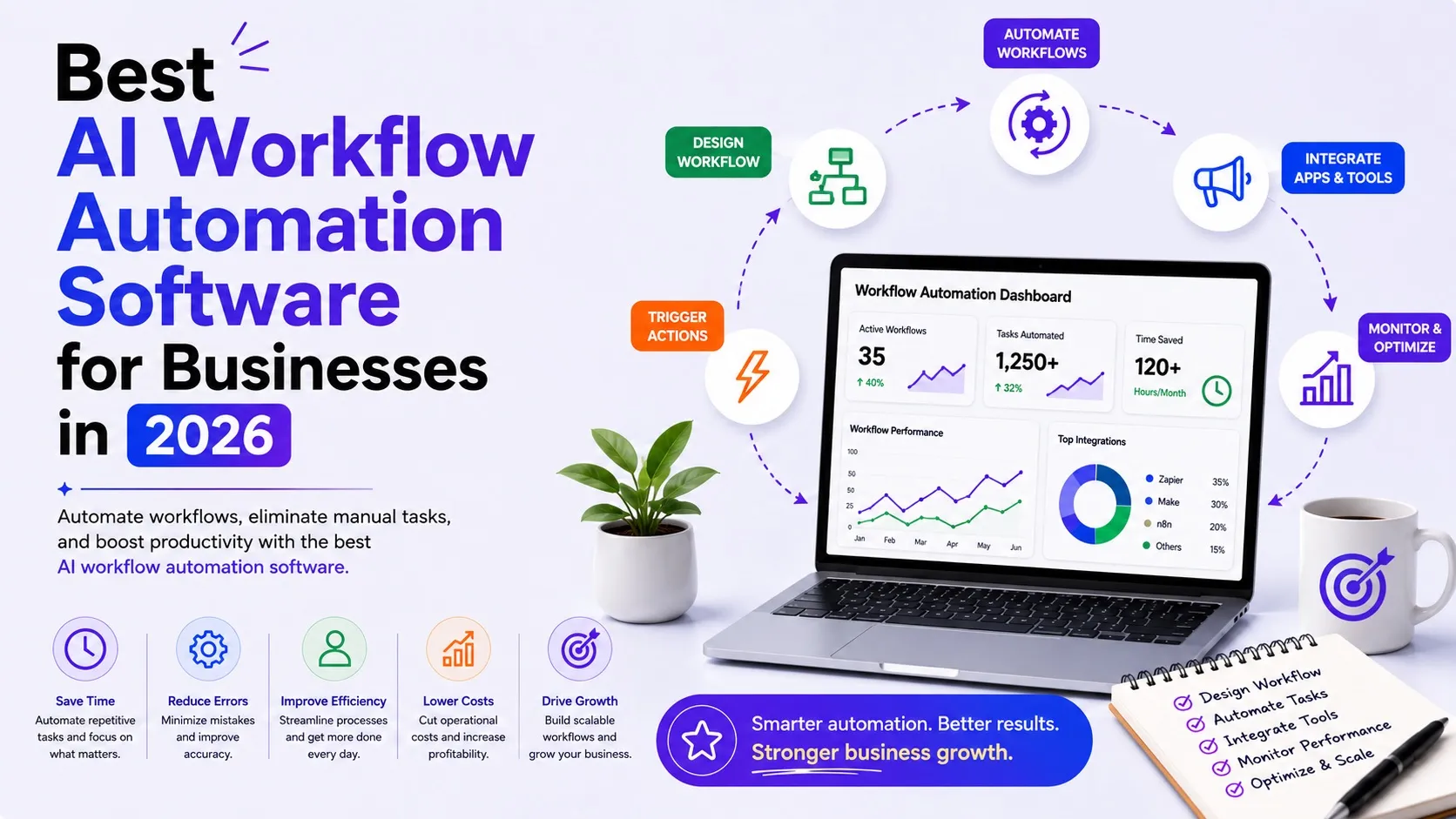
As businesses adopt artificial intelligence to streamline operations, AI workflow automation software has become one of the most valuable technology investments. From automating lead management and customer support to invoice processing and marketing campaigns, AI-powered workflow platforms help organizations eliminate repetitive work, reduce errors, and improve productivity.
Unlike traditional workflow tools, today’s AI automation platforms can analyze data, make intelligent decisions, generate content, summarize documents, and connect hundreds of business applications into seamless workflows. Whether you’re a startup, small business, agency, or enterprise, the right workflow automation software can save hundreds of hours each month while improving customer experiences and operational efficiency.
In this guide, we’ll compare the best AI workflow automation software for businesses in 2026, examine their strengths and weaknesses, and help you choose the right platform based on your business needs.
If you’re new to AI automation, you may also find these guides helpful:
- Best AI Workflows for Small Businesses
- AI Workflow Automation for Small Businesses
- Workflow Automation for Small Businesses
What Is AI Workflow Automation Software?
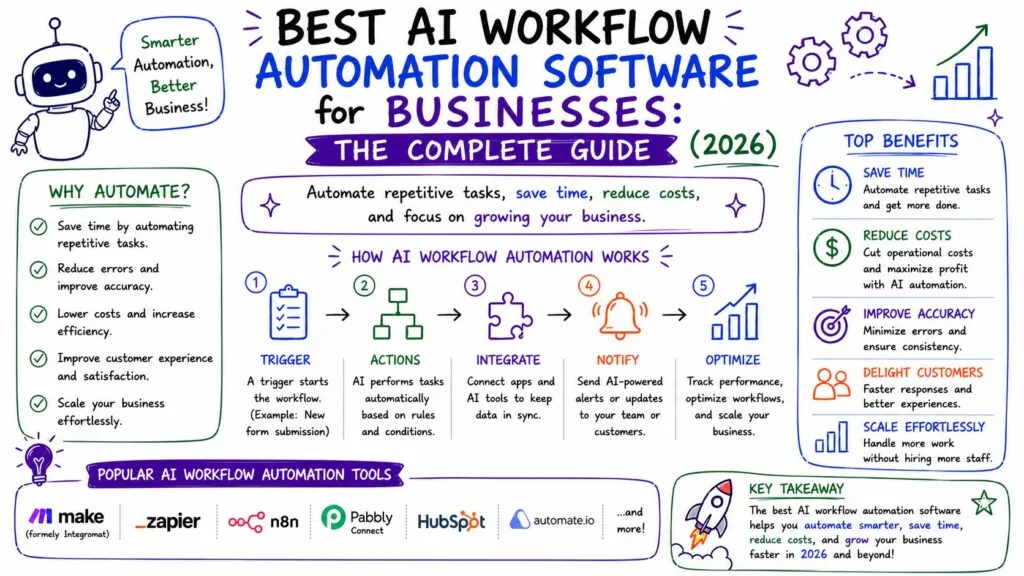
AI workflow automation software helps businesses automate repetitive tasks while using artificial intelligence to make smarter decisions throughout a workflow.
Instead of relying solely on predefined rules, AI-powered workflows can:
- Classify and prioritize tasks
- Generate emails and reports
- Summarize documents
- Score sales leads
- Route customer support tickets
- Predict customer behavior
- Trigger actions based on business conditions
- Integrate multiple applications without manual intervention
For example, when a customer submits a contact form, AI can qualify the lead, update your CRM, notify the appropriate salesperson, generate a personalized follow-up email, and schedule a meeting—all without human input.
Why Businesses Need AI Workflow Automation
Businesses of all sizes are embracing AI automation because it improves efficiency while reducing operational costs.
Key Benefits
- Save time on repetitive tasks
- Reduce manual data entry
- Improve cross-team collaboration
- Deliver faster customer responses
- Increase process consistency
- Scale operations without expanding headcount
- Improve reporting and decision-making
- Connect multiple business applications
If you’re looking for practical implementation strategies, see How Small Businesses Can Save 20 Hours Per Week Using AI.
How We Evaluated These Platforms
To create this list, we evaluated each solution based on:
- AI capabilities
- Workflow flexibility
- Ease of use
- Number of integrations
- Automation depth
- Collaboration features
- Security
- Pricing
- Scalability
- Overall value for businesses
Quick Comparison Table
| Software | Best For | AI Features | Free Plan |
|---|---|---|---|
| Make | Advanced visual automation | AI modules, multi-step workflows | Yes |
| Zapier | Easy app integrations | AI builder, AI Actions | Yes |
| n8n | Developers & technical teams | AI agents, custom logic | Yes |
| Workato | Enterprise automation | AI copilots, enterprise orchestration | No |
| Microsoft Power Automate | Microsoft ecosystem | AI Builder, document intelligence | Yes |
| Airtable | Business operations | AI fields, AI assistants | Yes |
| ClickUp | Team productivity | AI writing, task automation | Yes |
| Monday.com | Workflow management | AI automations, summaries | Yes |
Best AI Workflow Automation Software
1. Make
Best For: Businesses needing advanced visual workflow automation
Make is one of the most flexible automation platforms available. Its drag-and-drop interface allows businesses to build sophisticated workflows across thousands of applications without writing code.
Key Features
- Visual workflow builder
- AI integrations
- Multi-step automations
- API connectivity
- Error handling
- Scheduling
- Conditional logic
Pros
- Extremely flexible
- Excellent visual editor
- Strong AI integrations
Cons
- Complex workflows require planning
Ideal For: Agencies, ecommerce businesses, marketing teams, SaaS companies
2. Zapier
Best For: Quick business automation
Zapier is known for its ease of use and extensive integration library, connecting more than 7,000 applications.
Key Features
- AI-powered workflow builder
- Thousands of integrations
- Automated triggers
- Multi-step workflows
- AI Actions
- CRM synchronization
Pros
- Beginner-friendly
- Fast implementation
- Massive app ecosystem
Cons
- Advanced workflows can become expensive
Ideal For: Small businesses and growing teams
3. n8n
Best For: Developers and technical organizations
n8n is an open-source workflow automation platform that offers complete control over automation logic and deployment.
Key Features
- Self-hosting
- AI agents
- API automation
- JavaScript support
- Custom integrations
- Advanced branching
Pros
- Highly customizable
- Cost-effective
- Strong developer community
Cons
- Requires technical expertise
4. Workato
Best For: Enterprise workflow automation
Workato combines enterprise-grade automation with AI-powered copilots and extensive integration capabilities.
Key Features
- Enterprise orchestration
- AI copilots
- Workflow governance
- Security controls
- Business process automation
- Advanced integrations
Pros
- Enterprise-ready
- Excellent scalability
- Strong compliance features
Cons
- Premium pricing
5. Microsoft Power Automate
Best For: Microsoft 365 users
Organizations already using Microsoft products benefit from seamless integration with Office, Teams, SharePoint, and Dynamics 365.
Key Features
- AI Builder
- Robotic Process Automation (RPA)
- Document processing
- Approval workflows
- Power Platform integration
Pros
- Excellent Microsoft integration
- Powerful enterprise capabilities
Cons
- Best suited for Microsoft environments
6. Airtable
Best For: Operations and data management
Airtable combines database functionality with workflow automation and AI features.
Key Features
- AI fields
- Workflow automation
- Project management
- Custom databases
- Dashboards
Pros
- Easy collaboration
- Flexible data structures
Cons
- Advanced automations require paid plans
7. ClickUp
Best For: Project and operations management
ClickUp combines project management with AI writing, workflow automation, and team collaboration.
Key Features
- AI assistant
- Task automation
- Documentation
- Goal tracking
- Templates
Pros
- All-in-one workspace
- Excellent value
Cons
- Feature-rich interface can overwhelm new users
8. Monday.com
Best For: Workflow and campaign management
Monday.com helps teams automate recurring work, manage approvals, and monitor projects through customizable dashboards.
Key Features
- AI-powered summaries
- Workflow automations
- Project tracking
- Team collaboration
- Reporting dashboards
Pros
- User-friendly
- Excellent visual reporting
Cons
- Automation limits on entry-level plans
Best AI Workflow Software by Use Case
| Use Case | Recommended Software |
|---|---|
| Small Businesses | Zapier, Make |
| Marketing Automation | Make, HubSpot, Monday.com |
| Sales Automation | Make, HubSpot, Power Automate |
| Customer Support | Make, Zapier, Power Automate |
| Enterprise Automation | Workato, Microsoft Power Automate |
| Developers | n8n |
| Operations Teams | Airtable, ClickUp |
Example AI Workflow
Lead Captured
↓
AI Scores Lead
↓
CRM Updated
↓
Sales Notification
↓
AI Generates Personalized Email
↓
Meeting Scheduled
↓
Proposal Created
↓
Customer Onboarded
↓
Support Workflow Activated
↓
Performance Dashboard Updated
This type of end-to-end automation is covered in more detail throughout our workflow guides, including:
- AI Sales Workflow
- AI Marketing Workflow
- AI Workflow for Customer Support
- AI Workflow for Customer Retention
- AI Workflow for Invoice Processing and Financial Reporting
How to Choose the Right AI Automation Platform
When evaluating workflow automation software, consider the following:
Ease of Use
If your team has limited technical expertise, prioritize platforms with visual workflow builders and pre-built templates.
Integrations
Choose software that connects with your CRM, accounting tools, email platform, communication apps, and project management software.
AI Capabilities
Look for features such as AI copilots, content generation, predictive analytics, document processing, and intelligent routing.
Scalability
Select a platform that can support your business as it grows without requiring a complete migration.
Security
For businesses handling sensitive customer or financial data, evaluate compliance features, access controls, and audit logging.
Frequently Asked Questions
What is AI workflow automation software?
AI workflow automation software combines workflow automation with artificial intelligence to automate repetitive business tasks, improve decision-making, and connect business applications.
Which AI workflow automation software is best?
Make is an excellent choice for flexible automation, Zapier is ideal for ease of use, n8n suits technical teams, Workato targets enterprises, and Microsoft Power Automate is best for Microsoft-centric organizations.
Can small businesses use AI workflow automation?
Yes. Many platforms offer free plans and no-code workflow builders, making AI automation accessible for startups and small businesses.
What is the difference between workflow automation and AI workflow automation?
Traditional workflow automation follows predefined rules, while AI workflow automation incorporates machine learning, natural language processing, predictive analytics, and intelligent decision-making.
Is AI workflow automation worth the investment?
For most businesses, yes. Automating repetitive processes can improve productivity, reduce operational costs, minimize errors, and enable teams to focus on higher-value work.
Final Verdict
AI workflow automation software has become a critical component of modern business operations. The right platform can automate repetitive work, improve collaboration, and connect your marketing, sales, finance, customer support, and operations into a single intelligent ecosystem.
For most small and mid-sized businesses, Make offers the best balance of flexibility, integrations, and AI capabilities. Zapier remains the easiest platform to adopt, while n8n is an excellent choice for technical teams seeking full customization. Enterprises with complex requirements should evaluate Workato or Microsoft Power Automate, and operations-focused organizations can benefit from Airtable, ClickUp, or Monday.com.
Choose a solution that integrates well with your existing tools, supports your growth plans, and provides the AI features that align with your business goals.