
Time to Read:
Table of Contents
Introduction
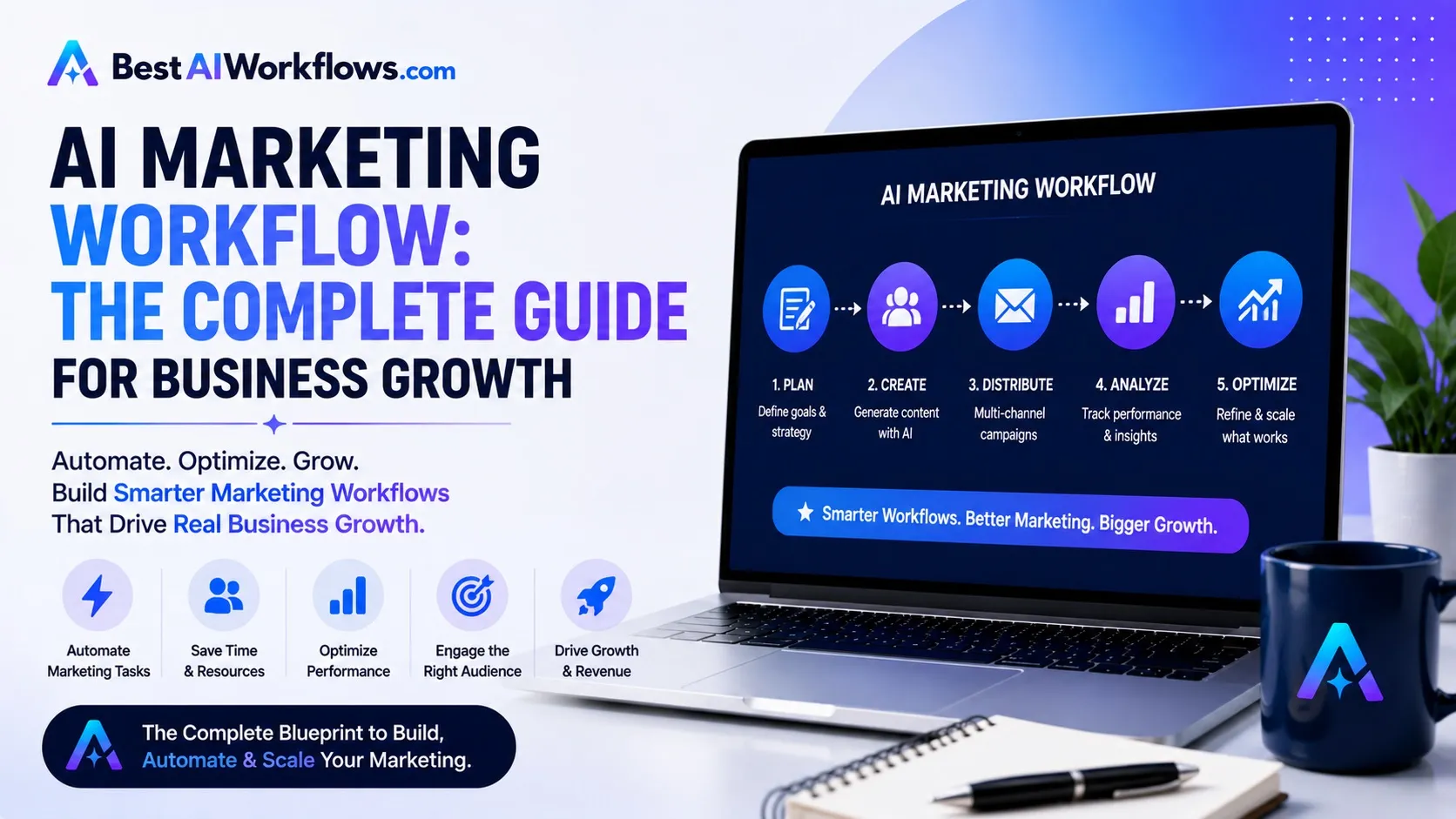
Marketing teams are under constant pressure to create more content, launch campaigns faster, generate qualified leads, and prove return on investment (ROI). Managing these responsibilities manually is no longer practical, especially for growing businesses. Artificial intelligence (AI) and workflow automation have changed how marketing teams operate by eliminating repetitive tasks, improving collaboration, and providing data-driven insights.
An AI marketing workflow connects multiple marketing tools into a streamlined process that automates planning, content creation, SEO research, email marketing, social media publishing, lead nurturing, analytics, and reporting. Instead of switching between disconnected applications, businesses can create repeatable workflows that save time and improve campaign performance.
Whether you’re a startup, agency, SaaS company, or enterprise marketing team, implementing AI marketing automation can dramatically increase productivity while reducing operational costs.
This guide explains how to build an effective AI marketing workflow, highlights recommended tools, and shares practical examples that you can implement immediately.
What Is an AI Marketing Workflow?
An AI marketing workflow is a structured sequence of marketing activities enhanced by artificial intelligence and automation. It combines AI-powered software with workflow automation platforms to handle repetitive tasks, allowing marketers to focus on strategy, creativity, and customer engagement.
A typical AI marketing workflow includes:
- Content planning
- Keyword research
- Content creation
- SEO optimization
- Email marketing
- Social media scheduling
- Lead management
- Performance reporting
Instead of manually completing every task, AI tools execute actions automatically based on predefined triggers and business rules.
For businesses looking to automate operations beyond marketing, read Best AI Workflows for Small Businesses.
Benefits of AI Marketing Automation
Save Time
AI automates repetitive activities such as drafting emails, scheduling posts, updating CRM records, and generating reports.
Improve Content Quality
AI writing assistants help marketers produce blogs, landing pages, advertisements, and email campaigns faster while maintaining consistent quality.
Better Lead Management
Marketing automation qualifies leads and transfers high-intent prospects directly to the sales team.
Learn more in How to Build an AI Lead Generation Workflow.
Improve Collaboration
Marketing, sales, and customer success teams work from the same data, reducing communication gaps.
Increase Marketing ROI
Automation allows businesses to launch campaigns faster while tracking performance across multiple channels.
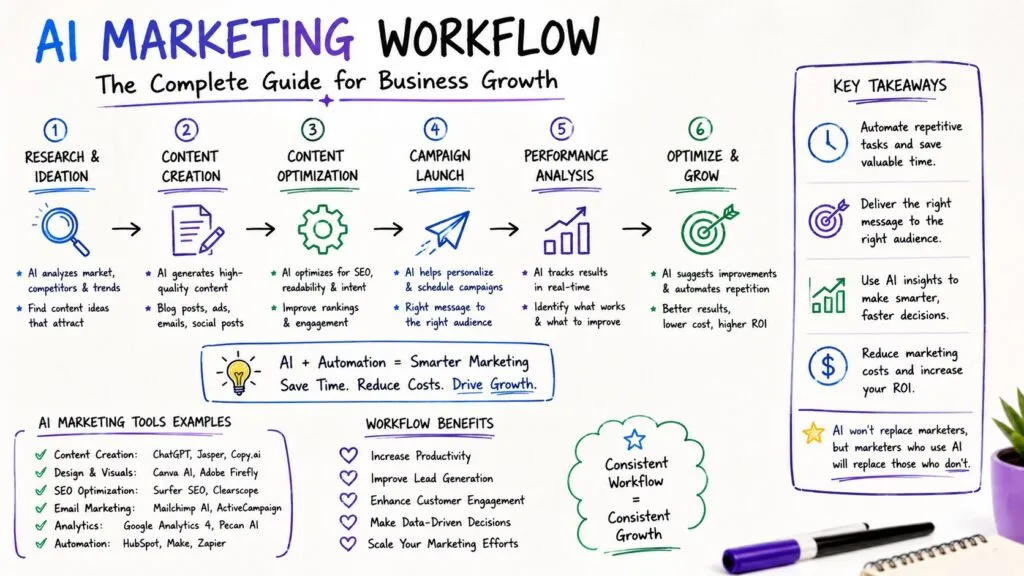
Core Components of an AI Marketing Workflow
1. Content Planning
Every successful campaign begins with a content strategy.
AI tools help marketing teams:
- Brainstorm ideas
- Build editorial calendars
- Analyze trends
- Identify content gaps
- Prioritize topics
Recommended tools:
- Notion AI
- ClickUp AI
- ChatGPT
2. SEO Research
AI accelerates keyword research by identifying search opportunities, analyzing competitors, and recommending content improvements.
Typical SEO workflow:
Topic Idea
↓
Keyword Research
↓
Competitor Analysis
↓
Content Brief
↓
SEO Optimization
Recommended tools:
- Semrush
- Surfer SEO
- Google Search Central
Official resource: https://developers.google.com/search
3. AI Copywriting
Once keywords are selected, AI can generate:
- Blog posts
- Product descriptions
- Email sequences
- Ad copy
- Landing pages
- Social captions
AI speeds up content creation, but every draft should be reviewed by a human editor to ensure accuracy, tone, and brand consistency.
4. Email Campaign Automation
Email marketing remains one of the highest-converting digital channels.
AI workflows can automatically:
- Welcome new subscribers
- Segment audiences
- Personalize email content
- Recommend products
- Schedule campaigns
- Trigger follow-up sequences
Example workflow:
Lead Captured
↓
CRM Updated
↓
Welcome Email
↓
Educational Sequence
↓
Product Recommendation
↓
Sales Notification
5. Social Media Automation
Managing multiple social platforms manually is time-consuming.
AI helps by:
- Generating captions
- Scheduling posts
- Recommending publishing times
- Repurposing content
- Monitoring engagement
Popular platforms include Buffer, Hootsuite, and HubSpot.
6. Analytics
Marketing decisions should be based on data rather than assumptions.
AI analytics platforms monitor:
- Website traffic
- Conversion rates
- Campaign ROI
- Customer behavior
- Lead sources
- Engagement metrics
Official resource: https://developers.google.com/analytics
7. Reporting
Instead of manually creating weekly reports, AI automatically combines marketing data from multiple platforms into interactive dashboards.
Typical metrics include:
- Website visitors
- Leads generated
- Email open rates
- Social engagement
- Revenue attribution
- Customer acquisition cost
Step-by-Step AI Marketing Workflow
Step 1: Plan Campaigns
Create marketing objectives and define target audiences.
↓
Step 2: Research Keywords
Identify commercial and informational search opportunities using AI-powered SEO tools.
↓
Step 3: Create Content
Generate blogs, landing pages, videos, and email campaigns using AI writing assistants.
↓
Step 4: Optimize for SEO
Improve headings, keywords, readability, internal links, and metadata before publishing.
↓
Step 5: Distribute Content
Automatically publish content across your website, email campaigns, and social media channels.
↓
Step 6: Capture Leads
Website visitors complete forms, download resources, or request demos.
↓
Step 7: Qualify Leads
AI evaluates engagement, assigns lead scores, and updates your CRM.
For sales integration, explore AI Sales Workflow: The Complete Guide for Modern Businesses.
↓
Step 8: Analyze Results
Measure campaign performance and use AI recommendations to improve future campaigns.
AI Marketing Workflow Example
| Stage | AI Tool | Outcome |
|---|---|---|
| Content Planning | Notion AI | Campaign calendar |
| SEO Research | Semrush | Target keywords |
| Writing | ChatGPT | First draft |
| Optimization | Surfer SEO | SEO improvements |
| HubSpot | Automated nurture | |
| Social Media | Buffer | Scheduled publishing |
| Analytics | Google Analytics | Campaign insights |
| Reporting | Looker Studio | Executive dashboard |
Recommended AI Marketing Tools
| Tool | Best For |
|---|---|
| HubSpot | Marketing automation |
| ChatGPT | Content creation |
| Semrush | SEO research |
| Surfer SEO | Content optimization |
| Canva | Visual content |
| Buffer | Social media scheduling |
| Make | Workflow automation |
| Zapier | App integrations |
| Notion AI | Campaign planning |
| Grammarly | Editing |
Marketing agencies looking for specialized solutions should also read: Best AI Workflows for Small Businesses
Businesses wanting a complete sales and marketing technology stack should explore: Best AI Tools for Sales Teams.
Common Mistakes to Avoid
Automating Poor Processes
AI improves existing workflows but cannot fix inefficient processes.
Using Too Many Tools
Choose an integrated technology stack instead of purchasing disconnected software.
Ignoring Human Review
AI-generated content should always be reviewed before publication.
Measuring the Wrong Metrics
Focus on business outcomes such as qualified leads, conversions, and revenue rather than vanity metrics.
Frequently Asked Questions
What is an AI marketing workflow?
An AI marketing workflow combines artificial intelligence with workflow automation to streamline marketing tasks such as planning, SEO, content creation, email campaigns, social media management, analytics, and reporting.
Which businesses benefit from AI marketing automation?
Startups, agencies, ecommerce businesses, SaaS companies, and enterprise organizations can all improve efficiency and campaign performance through AI marketing workflows.
What are the best AI marketing tools?
HubSpot, ChatGPT, Semrush, Surfer SEO, Make, Zapier, Canva, Notion AI, and Buffer are among the leading platforms.
Can AI replace marketers?
No. AI automates repetitive work and provides insights, but strategy, creativity, and brand decisions remain human responsibilities.
How do AI marketing workflows improve business growth?
They reduce manual work, improve campaign consistency, accelerate lead generation, and help businesses make data-driven marketing decisions.
Final Verdict
An AI marketing workflow enables businesses to automate repetitive marketing activities while improving collaboration, campaign performance, and customer engagement. By integrating content planning, SEO research, AI copywriting, email marketing, social media management, analytics, and reporting into a single workflow, marketing teams can scale their efforts without increasing operational complexity.
For most businesses, the best approach is to start with a small automation project—such as AI-assisted content creation or email nurturing—and gradually expand into a fully connected marketing ecosystem. Combined with CRM integration and AI-powered sales workflows, these processes create a repeatable growth engine capable of supporting long-term business success.