
Time to Read:
Table of Contents
Quick Answer
AI customer success automation uses AI, customer data, and automated workflows to monitor customer health, automate onboarding, identify churn risks, personalize engagement, prepare renewals, and surface expansion opportunities.
The best approach isn’t to automate every customer interaction. Instead, businesses should automate repetitive monitoring and operational work while keeping CSMs responsible for strategic decisions and important customer relationships.
A practical customer success automation system looks like:
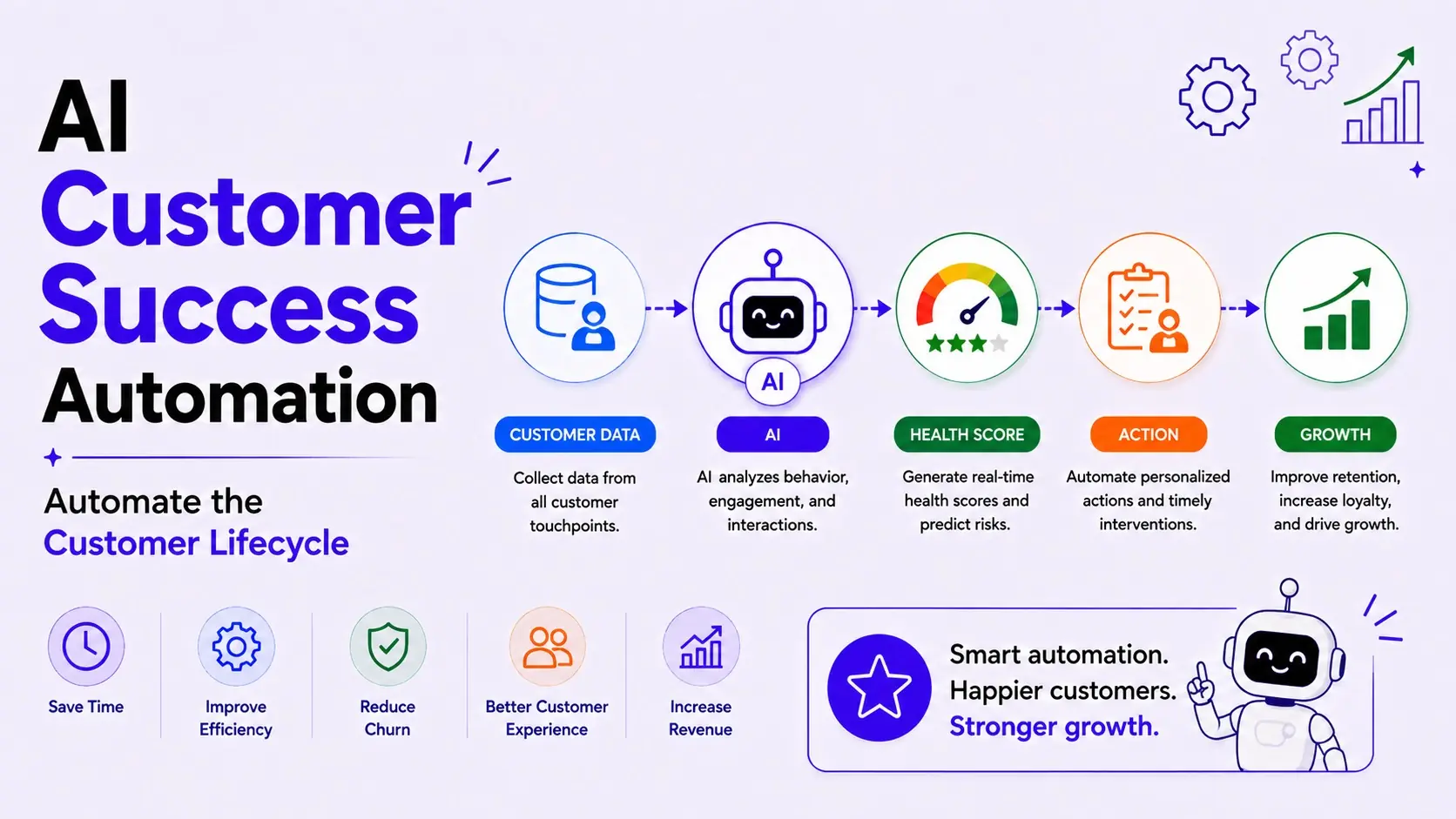
Customer Data → AI Analysis → Health Score → Risk/Opportunity Detection → Automated Playbook → CSM Action → Outcome Tracking
This approach allows customer success teams to become more proactive without simply adding more manual work.
What Is AI Customer Success Automation?
AI customer success automation is the use of artificial intelligence, customer data, and workflow automation to proactively manage customers throughout their lifecycle.
Traditional customer success teams often depend on CSMs manually checking accounts, updating spreadsheets, preparing reports, monitoring product usage, and remembering when customers need follow-up.
That model becomes difficult as the customer base grows.
AI can bring together signals from:
- CRM records
- Product usage
- Support tickets
- Customer surveys
- Emails
- Meetings
- Billing information
- Renewal dates
- Customer sentiment
- Feature adoption
It can then identify patterns and trigger appropriate workflows.
For example:
A customer’s product usage has declined, support sentiment has become negative, and their renewal is approaching.
Rather than waiting for a CSM to discover the problem during a monthly account review, an AI system can flag the account immediately and create a recommended intervention.
This represents a shift from reactive customer success to proactive customer success.
Current customer-success platforms increasingly describe health scoring as a real-time action system rather than simply a reporting dashboard. ChurnZero, for example, describes AI-enhanced health scoring as combining product usage, support history, surveys, and other signals to identify risks and opportunities and turn them into actions.
AI Customer Success Automation vs Traditional Automation
There are two important layers of automation.
Rule-based automation
A predefined condition triggers an action.
Example:
Customer hasn’t completed onboarding after 14 days → send reminder.
This is useful, predictable, and easy to understand.
AI-powered automation
AI interprets multiple signals and determines what they mean.
Example:
Product adoption is falling, the customer’s main champion has become less engaged, support sentiment has deteriorated, and renewal is approaching.
The system can identify this combination as a potential churn risk.
The strongest customer success systems combine both:
Rules for predictable processes.
AI for interpretation and prioritization.
Humans for judgment and relationships.
The Customer Success Automation Lifecycle
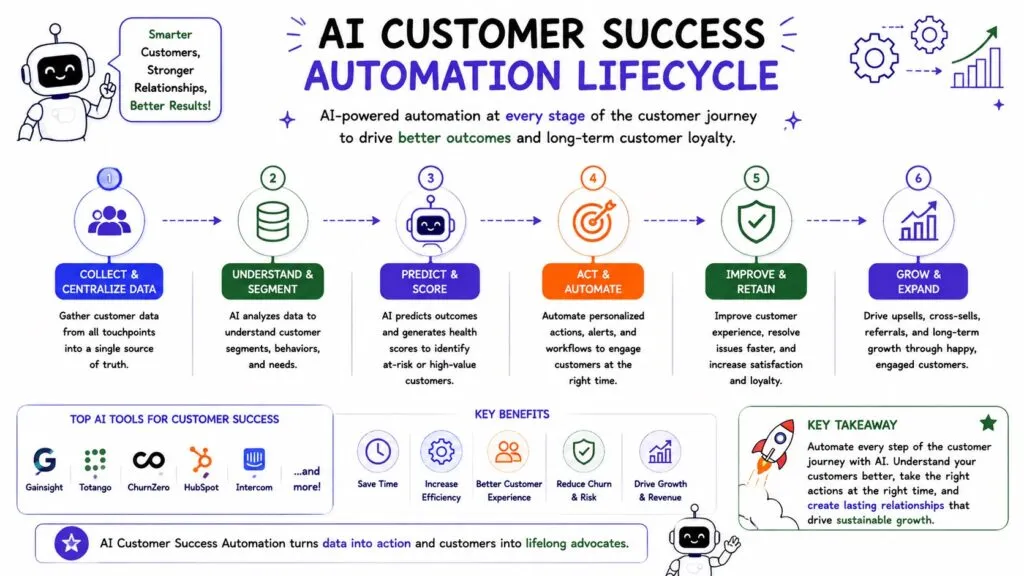
Customer success automation should cover the entire customer journey:
Onboarding
↓
Activation
↓
Adoption
↓
Engagement
↓
Health Monitoring
↓
Retention
↓
Renewal
↓
Expansion
↓
Advocacy
Different stages require different automation.
For example, onboarding automation focuses on time-to-value, while retention automation focuses on identifying risk and intervening before cancellation.
The AI Customer Success Workflow
A practical architecture looks like this:
CRMProduct AnalyticsSupportBillingCustomer Feedback ↓Unified Customer Data ↓AI Analysis ↓Customer Health Score ↓Risk / Opportunity Detection ↓Playbook Selection ↓Automated Action ↓CSM Intervention When Needed ↓Outcome Tracking ↓Model / Workflow Improvement
This is the core framework I recommend for businesses implementing customer success automation.
The important point is that the health score should lead to an action.
A dashboard that shows a customer in red but doesn’t tell the team what to do is not a complete automation system.
Customer Onboarding Automation
Onboarding is one of the easiest places to start.
A typical manual process might require a CSM to:
- Send welcome emails
- Schedule meetings
- Track setup
- Monitor milestones
- Remind customers about incomplete tasks
- Update CRM records
- Prepare progress reports
These tasks can be partially automated.
Example AI Onboarding Workflow
New customer created
↓
CRM record generated
↓
Onboarding plan selected
↓
Welcome message sent
↓
Setup milestones tracked
↓
AI monitors progress
↓
Customer falls behind
↓
Personalized reminder
↓
CSM notified if intervention is needed
The important difference is personalization.
Instead of sending every customer the same reminder, AI can use the customer’s stage, product usage, industry, and previous interactions to determine what information is most useful.
Next Step
Want to build customer workflows beyond onboarding?
See AI Customer Success Workflow for a practical workflow architecture covering health scoring, retention, and CSM intervention.
AI Customer Health Scoring
Customer health scoring is arguably the central component of AI customer success automation.
A basic health score might combine:
| Signal | Example Weight |
|---|---|
| Product adoption | 25% |
| Engagement | 20% |
| Support health | 15% |
| Customer sentiment | 15% |
| Business outcomes | 15% |
| Renewal signals | 10% |
These weights are illustrative, not universal.
Your business should determine its weighting from actual customer outcomes.
For example, Gainsight’s current customer-success material highlights the importance of using customer data to challenge assumptions about which signals actually predict outcomes. In one 2026 example, daily logins weren’t necessarily predictive for an enterprise segment, while cyclical engagement patterns were more useful.
That leads to a useful principle:
Don’t copy a vendor’s health-score formula. Learn what predicts success in your own customer base.
Example score
Health: 84/100
- Product adoption: Strong
- Engagement: Strong
- Support sentiment: Positive
- Renewal: Low risk
Recommended action: Continue standard engagement and identify expansion opportunities.
Compare that with:
Health: 42/100
- Usage down 35%
- Key feature adoption declining
- Support sentiment deteriorating
- Renewal in 75 days
Recommended action: Trigger retention playbook and assign CSM intervention.
Churn Prevention With AI
The best churn workflow doesn’t wait for the customer to say:
“We’re cancelling.”
It looks for leading indicators.
Potential signals include:
- Declining product usage
- Reduced feature adoption
- Fewer active users
- Negative support sentiment
- Increased support volume
- Missed meetings
- Low survey scores
- Champion changes
- Unresolved problems
- Approaching renewal
AI Churn Workflow
Customer Activity Changes ↓AI Detects Pattern ↓Health Score Drops ↓Churn Risk Identified ↓AI Generates Risk Summary ↓Retention Playbook Triggered ↓CSM Reviews ↓Customer Intervention ↓Outcome Recorded
The AI-generated risk summary is particularly valuable.
Instead of:
Account XYZ: At Risk
the CSM should receive:
Account XYZ: At Risk
Product usage has declined 32% over 30 days. Adoption of the primary feature has fallen, and two recent support conversations indicate dissatisfaction. Renewal is 68 days away.
That gives the CSM context before contacting the customer.
Automate Customer Engagement
Not every customer needs the same communication frequency.
AI can help determine when engagement should increase or decrease.
Healthy Customer
Strong usage + positive sentiment.
Action: Educational content, advocacy, expansion opportunities.
Declining Engagement
Usage falling but no major problems.
Action: Personalized education or check-in.
High-Risk Customer
Usage falling + negative sentiment + renewal approaching.
Action: CSM escalation.
This is much more effective than sending identical lifecycle emails to every account.
Automate Customer Education
Customer success often overlaps with knowledge management.
If customers repeatedly struggle with the same feature, the system can recommend:
- Help articles
- Tutorials
- Product documentation
- Training
- Webinars
- Best-practice guides
For example:
Low feature adoption
↓
AI identifies missing knowledge
↓
Relevant guide recommended
↓
Customer completes training
↓
Usage monitored
↓
Adoption improves
This connects customer success with your broader knowledge-management strategy.
For the implementation side, see AI Knowledge Management: The Complete Guide for Businesses and Best AI Knowledge Base Software in 2026.
Automate QBR Preparation
Quarterly Business Reviews can consume significant CSM time.
A typical QBR requires gathering:
- Customer goals
- Product usage
- Adoption
- Support history
- Business outcomes
- Health score
- Open issues
- Renewal status
- Expansion opportunities
AI can assemble this information automatically.
QBR Automation Workflow
QBR approaching
↓
Collect account data
↓
Analyze usage
↓
Summarize support history
↓
Review customer goals
↓
Analyze health
↓
Identify wins and risks
↓
Identify expansion opportunities
↓
Generate QBR brief
↓
CSM reviews
↓
Customer meeting
The CSM remains responsible for the relationship and final presentation.
AI handles the preparation.
Renewal Automation
Renewals are another predictable workflow.
A simple framework might be:
| Time Before Renewal | Automated Action |
|---|---|
| 120 days | Review health |
| 90 days | Generate renewal brief |
| 60 days | Identify unresolved risks |
| 45 days | Notify account owner |
| 30 days | Trigger renewal process |
| 14 days | Escalate unresolved issues |
AI can make this more intelligent.
A healthy customer can follow a standard renewal workflow.
An at-risk customer can trigger an intervention plan.
This prevents your team from treating every renewal the same way.
Identify Expansion Opportunities
Customer success also contributes to revenue growth.
AI can look for signals such as:
- Usage approaching plan limits
- Increased users
- New departments adopting the product
- Frequent use of advanced features
- Requests for unavailable capabilities
- Strong customer sentiment
- Increased product usage
Example:
Customer has exceeded 85% of their contracted usage for three consecutive months.
The system can:
- Flag expansion opportunity.
- Update CRM.
- Notify account owner.
- Generate an account summary.
- Recommend the relevant plan.
- Prepare suggested outreach.
This creates a bridge between customer success automation and revenue automation.
What Should You Automate?
Not every customer-success activity should be autonomous.
Use this decision framework:
| Activity | Automate | AI Assist | Human |
|---|---|---|---|
| Usage monitoring | ✅ | ||
| Health-score calculation | ✅ | Review | |
| Routine reminders | ✅ | ||
| Account summaries | ✅ | ||
| Churn detection | ✅ | Review | |
| QBR preparation | ✅ | Review | |
| Renewal alerts | ✅ | ||
| Personalized low-risk education | ✅ | ||
| High-risk customer outreach | ✅ | ||
| Executive escalation | ✅ | ||
| Contract decisions | ✅ |
The rule is simple:
Automate the repetitive. Augment the analytical. Keep important relationships human.
How to Implement AI Customer Success Automation
Step 1: Map Your Customer Lifecycle
Document:
- Onboarding
- Activation
- Adoption
- Retention
- Renewal
- Expansion
Identify where CSMs spend the most repetitive time.
Step 2: Identify Your Data Sources
Start with:
- CRM
- Product analytics
- Support
- Billing
- Surveys
Step 3: Connect Your Systems
Create a unified customer view.
Your AI cannot make reliable recommendations if important customer information is trapped in disconnected systems.
Step 4: Define Health Signals
Determine what actually correlates with:
- Retention
- Churn
- Expansion
- Product adoption
Step 5: Start With One Workflow
Don’t automate the entire customer lifecycle on day one.
Start with something measurable, such as:
onboarding or churn-risk detection.
Step 6: Add AI
Use AI for:
- Summaries
- Sentiment
- Risk explanations
- Next-best-action recommendations
- Customer research
- QBR preparation
Step 7: Add Human Approval
Require CSM approval for high-impact customer communications.
Step 8: Measure Results
Track both operational and revenue outcomes.
Step 9: Improve the System
Use successful and unsuccessful customer outcomes to refine your health model and workflows.
Best Customer Success Automation Software
The major platforms can be grouped by their strengths:
| Platform | Best For | Key Strength |
|---|---|---|
| Gainsight | Enterprise CS | Health scoring and CS operations |
| ChurnZero | Retention-focused teams | Health and churn workflows |
| Totango | Customer journeys | Lifecycle orchestration |
| HubSpot | SMBs and growing businesses | CRM + service automation |
| Intercom | Engagement/support-led CS | AI + messaging workflows |
| Salesforce | Enterprise CRM environments | Customer data + automation |
| Zendesk | Support-led organizations | Service + customer context |
| Mixpanel | Product-led businesses | Product usage analytics |
ChurnZero’s 2026 health-score guidance emphasizes combining quantitative signals such as product usage and support history with richer relationship and sentiment information.
Gainsight also provides a useful example of using AI to improve health-score design rather than blindly relying on conventional metrics.
For customer communication and support workflows, Intercom’s current automation stack combines Workflows, Fin AI Agent, and Copilot. Its Workflows support branching logic, integrations, onboarding templates, routing, CSAT, and other automated processes.
Best For
Best for enterprise customer success: Gainsight
Best for churn-focused workflows: ChurnZero
Best for SMB CRM-centered teams: HubSpot
Best for AI-powered customer conversations: Intercom
Best for product-led businesses: Mixpanel
Measuring the ROI of AI Customer Success Automation
Don’t measure success by how many workflows you’ve created.
Measure business outcomes.
Customer Metrics
- Churn rate
- Retention rate
- Net Revenue Retention
- Product adoption
- Time to value
- Customer health
Productivity Metrics
- Accounts per CSM
- CSM administrative hours
- QBR preparation time
- Manual tasks eliminated
- Response time
Revenue Metrics
- Renewal rate
- Expansion revenue
- Upsell rate
- Cross-sell rate
- Revenue at risk
Simple ROI Framework
Suppose automation saves each CSM 5 hours per week.
For a team of 10:
5 × 10 = 50 hours saved per week
Annual capacity:
50 × 52 = 2,600 hours
You can then compare the value of those recovered hours against the software and implementation cost.
The second component is revenue impact:
Churn prevented + expansion revenue + productivity value = total potential business value
Use your actual customer economics rather than generic ROI claims.
Common Mistakes
Automating Everything
Customer relationships shouldn’t become robotic.
Using Bad Data
AI can’t fix incomplete CRM records or unreliable product telemetry.
Copying Vendor Health Scores
Your customers aren’t identical to another company’s customers.
Creating Scores Without Actions
A health score should lead to a workflow.
Ignoring Human Review
High-value or sensitive situations deserve human judgment.
Measuring Activity Instead of Outcomes
Thousands of automated messages don’t matter if churn doesn’t improve.
Frequently Asked Questions
What is AI customer success automation?
AI customer success automation uses AI, customer data, and automated workflows to manage repetitive customer-success processes such as onboarding, health monitoring, engagement, churn detection, renewals, and expansion.
How does AI help customer success teams?
AI can analyze customer signals, identify risks, summarize accounts, recommend next actions, automate routine communication, and alert CSMs when human intervention is needed.
Can AI predict customer churn?
AI can identify patterns associated with churn risk, but predictions are not guarantees. Accuracy depends on data quality, customer segmentation, historical outcomes, and model design.
What is customer lifecycle automation?
Customer lifecycle automation uses workflows and AI to manage customer interactions across stages including onboarding, activation, adoption, retention, renewal, and expansion.
Can AI replace customer success managers?
No. AI can reduce repetitive work and improve visibility, but CSMs remain important for strategic decisions, relationship management, complex interventions, and high-value customer conversations.
What is the best customer success automation software?
The best platform depends on your use case. Gainsight and ChurnZero are strong options for structured customer-success operations, HubSpot is attractive for CRM-centered teams, Intercom is strong for AI-powered customer communication, and Mixpanel is useful for product-led organizations.
How can a small business automate customer success?
Start with one high-volume workflow. Connect your CRM and customer-support data, automate onboarding reminders, establish basic health signals, and create alerts for declining engagement. Expand into AI-based scoring and churn detection after the fundamentals are working.
Final Verdict
AI customer success automation is not about replacing customer success managers. It’s about giving them a better operating system.
The traditional model is:
Customer problem → CSM discovers it → CSM investigates → CSM reacts
The AI-powered model is:
Customer signal → AI detects it → Risk/opportunity identified → Workflow triggered → CSM acts
That difference becomes increasingly valuable as customer portfolios grow.
The best implementation follows a simple lifecycle:
Onboard → Activate → Adopt → Monitor → Retain → Renew → Expand
Start with your existing customer data. Connect the CRM, product analytics, support, billing, and feedback systems. Build a health model based on your own customer outcomes, not generic assumptions. Then automate the repetitive workflows and use AI where interpretation adds value.
Most importantly, make every important score actionable.
A health score without a playbook is just another dashboard.
An AI-generated churn warning without a CSM intervention is just another notification.
The real value comes when:
Data → Insight → Action → Outcome
becomes a continuous system.