
Time to Read:
Table of Contents
Introduction
Every growing business eventually faces the same problem: employees know valuable things, but that knowledge is scattered everywhere.
Product information might live in Confluence. Company policies could be buried in Google Drive. Important decisions may exist only in Slack conversations, while sales processes, customer insights, and standard operating procedures are spread across multiple systems.
AI knowledge management software helps turn this fragmented information into searchable, accessible business knowledge.
Unlike a traditional internal wiki, modern AI knowledge platforms can understand natural-language questions, search across multiple sources, summarize information, generate documentation, and provide direct answers grounded in company data. Some platforms are increasingly adding AI agents that can use organizational knowledge to perform work as well.
That makes knowledge management especially important as businesses adopt AI automation: an AI system is considerably more useful when it has access to organized, accurate, permission-controlled company knowledge.
This guide compares some of the best AI knowledge management software in 2026, including Notion AI, Guru, Confluence, Document360, Slite, and Tettra.
For businesses primarily interested in creating documentation rather than managing organizational knowledge, see our Best AI Documentation Tools for Businesses guide.
What Is AI Knowledge Management Software?
AI knowledge management software helps businesses collect, organize, maintain, search, and retrieve organizational knowledge using artificial intelligence.
Traditional knowledge management depends heavily on folders, categories, keywords, and employees knowing where information is stored.
An AI knowledge base changes that experience.
Instead of searching:
refund policy enterprise customer
an employee might simply ask:
“What’s our process for approving a refund for an enterprise customer?”
The system can retrieve relevant company information and generate a direct response.
Depending on the platform, AI knowledge management software can provide:
- Natural-language search
- AI-generated answers
- Company wikis
- AI documentation creation
- Document summaries
- Knowledge verification
- Connected-source search
- SOP management
- Permission-aware answers
- AI agents
- Knowledge analytics
- Documentation automation
This creates a central intelligence layer employees can use across departments.
Best AI Knowledge Management Software: Quick Comparison
| Platform | Best For | Standout Capability |
|---|---|---|
| Notion AI | Best overall | Workspace + AI enterprise search |
| Guru | Enterprise knowledge | Knowledge Agents |
| Confluence + Rovo | Technical teams | Atlassian-connected knowledge |
| Document360 | Documentation-heavy businesses | AI-native knowledge bases |
| Slite | Internal knowledge | AI knowledge maintenance |
| Tettra | Small businesses | Simple internal wiki |
1. Notion AI — Best Overall AI Knowledge Management Software
Best for: Businesses wanting knowledge management, documentation, search, projects, and AI within one workspace.
Notion has evolved beyond being primarily a note-taking and documentation platform. Its current AI offering combines company knowledge, Enterprise Search, AI-assisted work, meeting notes, and agents within the broader Notion workspace.
Notion Enterprise Search can search across the workspace and connected applications such as Slack, Google Drive, GitHub, Jira, Microsoft Teams, SharePoint, and OneDrive. Answers include citations to their sources and follow existing permissions.
Key Features
- Company knowledge base
- Internal wiki
- Enterprise Search
- AI-generated answers
- AI connectors
- Document creation
- Research Mode
- Meeting notes
- Custom Agents
- Databases and projects
Pros
- Excellent all-in-one platform
- Strong AI search capabilities
- Flexible documentation
- Combines knowledge with everyday work
Cons
- Large workspaces require careful organization
- Some advanced AI functionality is associated with higher-tier plans
Best choice for: Startups, SMBs, agencies, and organizations wanting to consolidate multiple tools.
2. Guru — Best for Enterprise Knowledge Discovery
Best for: Companies whose knowledge is already distributed across many applications.
Guru’s Knowledge Agents are configurable AI agents that connect to organizational information and can answer questions, perform knowledge work, help maintain content quality, and run scheduled tasks.
A particularly useful capability is connected knowledge. Guru can draw from sources including Google Drive, Slack, Confluence, Salesforce, and native Guru content, generating answers with source references rather than requiring employees to search each application independently.
Key Features
- Knowledge Agents
- AI-powered answers
- Enterprise search
- Knowledge verification
- Connected sources
- Permission controls
- Knowledge analytics
Pros
- Strong knowledge governance
- Excellent for fragmented information
- Answers include source grounding
- Department-specific agents
Cons
- Smaller businesses may not need its full knowledge infrastructure
- Maximum value requires connecting and governing multiple information sources
Best choice for: Mid-market and enterprise organizations with information spread across multiple business systems.
3. Confluence + Rovo — Best for Technical and Product Teams
Best for: Engineering, IT, software, and product organizations.
Confluence has long been a popular business documentation platform, but Atlassian’s Rovo capabilities make it much more relevant to AI knowledge management.
Rovo can search across organizational data, provide natural-language answers, and work with specialized agents. In Confluence, teams can also use it to generate and summarize content.
Rovo’s natural-language search can return answers based on information users already have permission to access, with links back to relevant sources.
Key Features
- Internal documentation
- Rovo AI
- Natural-language knowledge search
- AI-generated summaries
- Content creation
- Knowledge agents
- Jira integration
- Automation
Pros
- Excellent Jira integration
- Mature documentation capabilities
- Particularly strong for technical knowledge
- AI integrated with existing Atlassian workflows
Cons
- Can feel complex for small non-technical teams
- Most valuable for organizations already using Atlassian products
Best choice for: Product, software development, engineering, and IT organizations.
4. Document360 — Best AI Documentation and Knowledge Base Platform
Best for: Businesses managing structured internal or customer-facing knowledge.
Document360 takes a documentation-first approach to knowledge management. Businesses can create knowledge bases, SOPs, user manuals, API documentation, and AI-powered self-service resources within the platform.
Its Eddy AI capabilities extend across content creation and knowledge discovery. Eddy can generate structured articles from prompts, recordings, audio, or transcripts, while Ask Eddy AI can provide contextual answers from knowledge-base content with citations.
Key Features
- AI knowledge bases
- Eddy AI
- AI article creation
- Assistive search
- SOP documentation
- Public and private knowledge bases
- AI chatbots
- Documentation analytics
Pros
- Documentation-focused platform
- Strong AI authoring features
- Suitable for customer self-service
- Public, private, and mixed knowledge-base configurations
Cons
- More specialized than all-in-one workspaces
- Businesses needing project management will require other software
Best choice for: SaaS companies, customer support teams, technical writers, and documentation-heavy organizations.
5. Slite — Best for Maintaining Internal Knowledge
Best for: Teams struggling with outdated internal documentation.
Creating documentation is relatively easy. Keeping hundreds of documents accurate is considerably harder.
Slite positions its AI knowledge base around this maintenance problem. Its platform helps teams find answers across their tools, identify documentation that needs attention, and address missing or outdated knowledge.
Key Features
- AI knowledge base
- Internal documentation
- AI search
- Knowledge maintenance
- Collaborative editing
- Documentation verification
Pros
- Clean interface
- Strong focus on internal knowledge
- Helps address outdated documentation
- Suitable for distributed teams
Cons
- More specialized than broader workspace platforms
- May require separate project-management software
Best choice for: Remote companies, startups, and teams prioritizing accurate internal knowledge.
6. Tettra — Best Simple Internal Wiki for Small Businesses
Best for: Smaller teams that want straightforward internal knowledge management.
Tettra is a useful alternative for businesses that don’t need the complexity of enterprise knowledge-management platforms.
It focuses on building a company knowledge base where employees can document processes, organize information, and retrieve answers through AI-assisted knowledge features.
Key Features
- Internal wiki
- Knowledge organization
- AI-assisted answers
- SOP storage
- Q&A workflows
- Content requests
Pros
- Straightforward knowledge management
- Suitable for smaller organizations
- Easier to adopt than many enterprise systems
Cons
- Less extensive than larger enterprise platforms
- Growing companies may eventually need broader search or governance capabilities
Best choice for: Small businesses and growing teams building their first structured internal knowledge base.
Best AI Knowledge Management Platform by Use Case
Choosing a winner depends heavily on what you’re trying to accomplish.
Best overall: Notion AI
Best enterprise knowledge platform: Guru
Best for product and engineering teams: Confluence + Rovo
Best for customer-facing knowledge bases: Document360
Best for internal knowledge maintenance: Slite
Best simple internal wiki: Tettra
A small company building its first internal wiki has very different requirements from an enterprise trying to search millions of documents across dozens of systems.
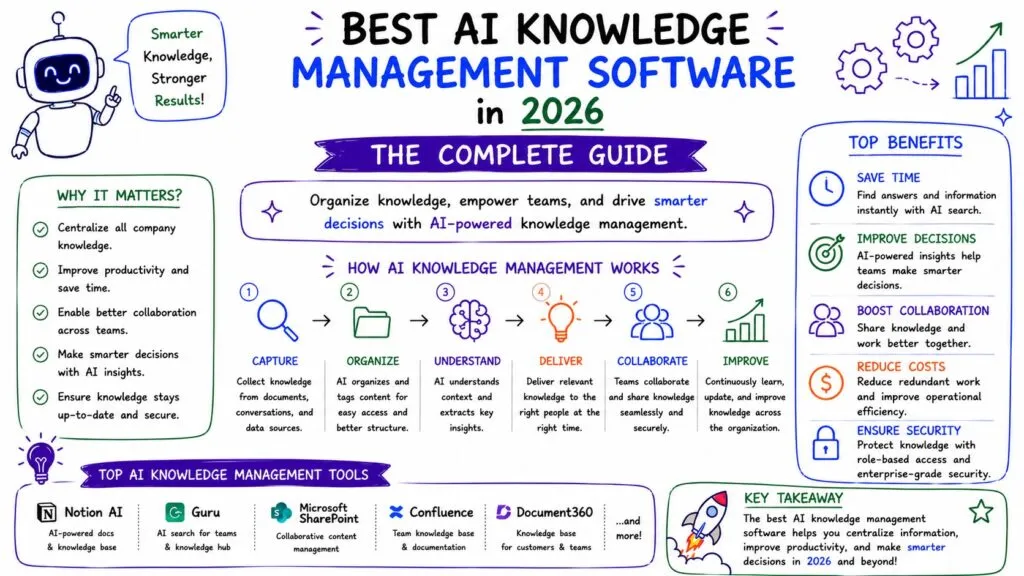
How AI Knowledge Management Works
A modern business knowledge workflow might look like this:
Employees Create Knowledge
↓
Documents + SOPs + Meetings + Conversations
↓
Knowledge Platform Indexes Information
↓
AI Organizes and Connects Context
↓
Employee Asks Natural-Language Question
↓
AI Searches Authorized Sources
↓
Relevant Information Retrieved
↓
Answer Generated With Sources
↓
Employee Takes Action
This becomes even more valuable when connected with AI agents.
Instead of merely asking:
“What is our new-customer onboarding process?”
an AI agent could potentially retrieve the approved process and then perform authorized actions within connected systems.
That connection between organizational knowledge and action is one reason businesses should consider knowledge management as part of their broader AI automation strategy.
AI Knowledge Base vs Traditional Internal Wiki
| Traditional Wiki | AI Knowledge Base |
|---|---|
| Keyword search | Natural-language questions |
| Users find documents | AI can generate direct answers |
| Mostly stored pages | Can connect multiple information sources |
| Manual discovery | Contextual retrieval |
| Static documentation | AI-assisted knowledge maintenance |
| Employees navigate folders | AI retrieves relevant information |
Traditional internal wiki software remains useful for storing structured information. AI makes that information easier to retrieve and potentially more actionable.
How Businesses Can Use AI Knowledge Management
Employee Onboarding
New employees can ask questions about company processes, benefits, software, policies, and responsibilities without repeatedly contacting managers.
Customer Support
Support representatives can retrieve product information, troubleshooting instructions, and policies while handling conversations.
Sales Enablement
Sales teams can quickly access pricing information, competitor comparisons, objection-handling guidance, and product documentation.
HR
Employees can retrieve policies, onboarding information, leave procedures, and internal guidelines.
Operations
Teams can access SOPs, process documentation, checklists, and operational policies from a centralized system.
For businesses building SOP libraries specifically, our AI SOP Generator: Create Standard Operating Procedures Faster guide covers the creation side of this workflow.
How to Choose AI Knowledge Management Software
1. Identify Where Your Knowledge Lives
If most company information already exists in one workspace, a platform such as Notion may make sense.
If information is distributed across Slack, Google Drive, Salesforce, Confluence, and other applications, prioritize strong cross-platform search.
2. Evaluate AI Answer Quality
Don’t judge a knowledge platform solely by whether it has an AI chatbot.
Look for:
- Source citations
- Permission-aware retrieval
- Search scope controls
- Knowledge verification
- Feedback mechanisms
3. Consider Documentation Capabilities
If your organization needs to create substantial documentation, evaluate authoring and knowledge-management features together.
Our Best AI Documentation Tools for Businesses comparison explores this area in more detail.
4. Evaluate Governance
Business knowledge can include sensitive information.
Review:
- User permissions
- Source permissions
- Admin controls
- Data retention
- Audit capabilities
- Security certifications
5. Think About AI Agents
Knowledge management and AI agents are increasingly connected.
An AI agent needs accurate business context to perform useful work. A well-maintained knowledge layer can provide that context.
Read What Are AI Agents? A Business Owner’s Guide for a broader explanation of how agents fit into business automation.
Frequently Asked Questions
What is AI knowledge management software?
AI knowledge management software helps businesses organize, search, maintain, and retrieve organizational information using artificial intelligence.
What is the best AI knowledge management software?
Notion AI is a strong all-around choice, Guru excels at enterprise knowledge discovery, Confluence works particularly well for technical organizations, and Document360 is strong for structured documentation and knowledge bases.
What is an AI knowledge base?
An AI knowledge base combines organized business information with AI-powered retrieval, allowing users to ask natural-language questions and receive relevant answers rather than manually searching through documents.
Can AI replace an internal wiki?
AI doesn’t necessarily replace the wiki itself. Instead, it can make wiki content easier to create, maintain, search, summarize, and retrieve.
Can AI knowledge management help employee onboarding?
Yes. New employees can use an AI knowledge system to retrieve policies, SOPs, product information, training material, and company processes without repeatedly asking colleagues where information is stored.
Final Verdict
The best AI knowledge management software depends on how your organization creates and consumes knowledge.
For businesses wanting an all-in-one workspace, Notion AI offers an attractive combination of documentation, knowledge management, AI search, projects, and increasingly agentic capabilities.
Guru is particularly strong for organizations whose knowledge already exists across numerous systems and needs to be surfaced through governed AI answers. Confluence + Rovo makes sense for technical teams embedded in the Atlassian ecosystem, while Document360 is a compelling choice for structured documentation and customer-facing knowledge bases.
Slite offers a focused approach to internal knowledge maintenance, while Tettra provides a simpler starting point for smaller businesses.
Whichever platform you choose, the objective should be bigger than building another document repository. A modern AI knowledge system should make organizational knowledge easy to create, verify, find, understand, and eventually act upon.
That foundation becomes increasingly valuable as your business introduces AI workflow automation and AI agents across sales, customer service, HR, marketing, finance, and operations.