
Introduction
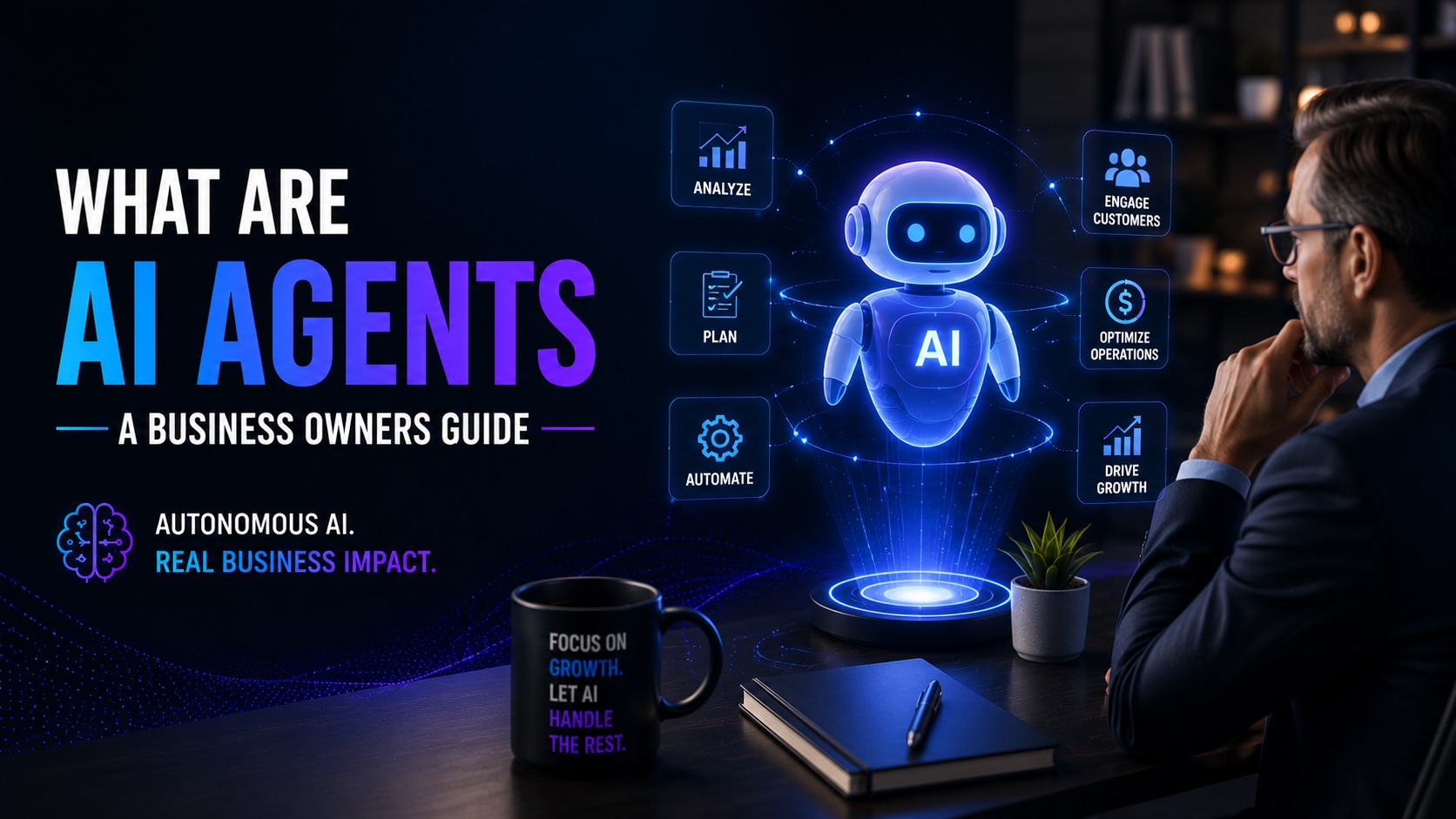
AI agents are quickly becoming one of the most important business technologies. While many companies have adopted AI chatbots and content generation tools, AI agents go much further. They can analyze information, make decisions, perform actions, communicate with software systems, and execute workflows with minimal human involvement.
For business owners, AI agents represent the next evolution of automation. Instead of simply generating text, these systems can handle operational processes such as customer support, lead qualification, reporting, scheduling, ecommerce operations, recruiting, and financial administration.
This guide explains AI agents in plain language, explores how they work, highlights practical business applications, and provides a roadmap for implementation.
What Are AI Agents?
An AI agent is a software system that can observe information, reason about goals, make decisions, and take actions to achieve specific outcomes.
Unlike traditional software that follows fixed rules, AI agents can adapt to changing conditions and determine the best course of action based on available information.
A simple example is a customer support agent that receives inquiries, identifies intent, searches a knowledge base, drafts responses, escalates complex issues, and updates a CRM automatically.
How AI Agents Differ From Traditional Automation
Traditional automation follows predefined rules. AI agents introduce reasoning and decision-making.
Traditional Automation:
• Fixed workflows
• Limited flexibility
• Requires predefined rules
AI Agents:
• Dynamic decision making
• Context awareness
• Goal-oriented behavior
• Ability to interact with multiple systems
• Continuous learning opportunities
This flexibility makes AI agents suitable for complex business environments.
Core Components of AI Agents
Most AI agents include several core components:
1. Input Layer
Receives information from emails, databases, websites, APIs, documents, or users.
2. Reasoning Engine
Analyzes information and determines appropriate actions.
3. Memory
Stores context and historical information.
4. Tool Access
Connects with business software.
5. Action Layer
Performs tasks such as updating records, sending emails, generating reports, or scheduling meetings.
Together these components enable autonomous task execution.
Types of AI Agents
Reactive Agents
Respond to events and inputs immediately.
Goal-Based Agents
Work toward defined business objectives.
Planning Agents
Create multi-step strategies before acting.
Multi-Agent Systems
Several specialized agents collaborate together.
Autonomous Agents
Operate with minimal human intervention while pursuing business goals.
How AI Agents Work
The workflow generally follows:
1. Receive input.
2. Analyze context.
3. Determine objective.
4. Select tools.
5. Execute actions.
6. Evaluate results.
7. Continue or escalate.
This process allows agents to manage workflows that previously required human oversight.
Business Benefits of AI Agents
Organizations are adopting AI agents because they can:
• Reduce operational costs
• Increase productivity
• Improve customer experiences
• Operate 24/7
• Scale without proportional hiring
• Reduce repetitive work
• Improve decision making
• Accelerate response times
AI Agents for Customer Support
Customer support is one of the most common applications. AI agents can answer questions, classify tickets, route issues, update CRM systems, and provide status updates automatically.
Businesses often reduce support workloads significantly while maintaining service quality.
AI Agents for Sales and Lead Generation
Sales agents can identify prospects, enrich lead data, score opportunities, schedule meetings, and automate follow-up communication.
These systems help sales teams focus on relationship building rather than administrative work.
AI Agents for Marketing
Marketing agents can perform keyword research, generate content briefs, create campaign drafts, monitor performance, and produce reports.
They accelerate execution while enabling marketers to focus on strategy.
AI Agents for Ecommerce
Ecommerce businesses use agents for inventory management, order processing, customer support, product recommendations, and fraud detection.
The result is improved efficiency and better customer experiences.
AI Agents for Recruiting
Recruiting agents can source candidates, screen resumes, schedule interviews, and communicate with applicants.
Agencies and HR teams benefit from faster hiring cycles and improved productivity.
AI Agents for Finance
Finance teams use agents for invoice processing, reconciliation, reporting, forecasting, and anomaly detection.
This reduces manual effort while improving accuracy.
Real-World Examples
Example 1: Customer Service Agent
Receives a support request, identifies intent, finds answers, drafts responses, and updates records.
Example 2: Reporting Agent
Collects information from multiple systems and produces executive summaries automatically.
Example 3: Ecommerce Operations Agent
Monitors inventory, identifies shortages, and triggers replenishment workflows.
Common Misconceptions
Myth: AI agents replace employees.
Reality: They usually augment employees.
Myth: Only large enterprises can use AI agents.
Reality: Small businesses increasingly deploy affordable solutions.
Myth: AI agents are fully autonomous today.
Reality: Most successful implementations include human oversight.
Challenges and Risks
Business owners should understand:
• Data privacy concerns
• Compliance requirements
• Hallucinations and inaccuracies
• Integration complexity
• Governance requirements
Proper implementation minimizes these risks.
How to Implement AI Agents
Step 1: Identify repetitive workflows.
Step 2: Define business goals.
Step 3: Select software tools.
Step 4: Build a pilot project.
Step 5: Measure results.
Step 6: Expand gradually.
Starting small usually produces the best outcomes.
Best Platforms for Building AI Agents
Popular options include:
• ChatGPT
• Claude
• Zapier
• Make
• HubSpot
• Salesforce
• Microsoft Copilot
• Agent frameworks and orchestration platforms
Each platform serves different business requirements.
The Future of AI Agents
Over the next several years, AI agents are expected to become more capable, more connected, and more autonomous.
Future developments may include:
• Cross-department coordination
• Autonomous business operations
• Predictive decision making
• Advanced multi-agent collaboration
• Industry-specific agent ecosystems
Frequently Asked Questions
What are AI agents for business?
AI-powered systems that can perform tasks, make decisions, and automate workflows.
Are AI agents the same as chatbots?
No. AI agents can take actions and execute workflows beyond conversation.
Can small businesses use AI agents?
Yes. Many affordable solutions are available.
What is an autonomous AI agent?
An agent that can perform tasks and pursue goals with limited supervision.
Do AI agents replace employees?
Typically no. They increase productivity and reduce repetitive work.
Final Verdict
AI agents represent one of the most important business technology trends of the decade. They combine automation, reasoning, decision-making, and software integration to help organizations operate more efficiently.
Business owners who understand AI agents today will be better positioned to benefit from the next wave of intelligent automation. The best approach is to begin with one workflow, measure results, and gradually expand adoption across the organization.