
Time to Read:
Table of Contents
Introduction
Winning a new customer is only the beginning of the customer journey. The real challenge lies in keeping customers engaged, helping them achieve their goals, and encouraging them to renew or expand their relationship with your business. This is where customer success becomes one of the most valuable business functions.
However, as businesses grow, managing hundreds or even thousands of customer relationships manually becomes increasingly difficult. Customer Success Managers (CSMs) spend countless hours monitoring customer health, sending follow-up emails, scheduling check-ins, updating CRM records, and identifying accounts at risk of churning.
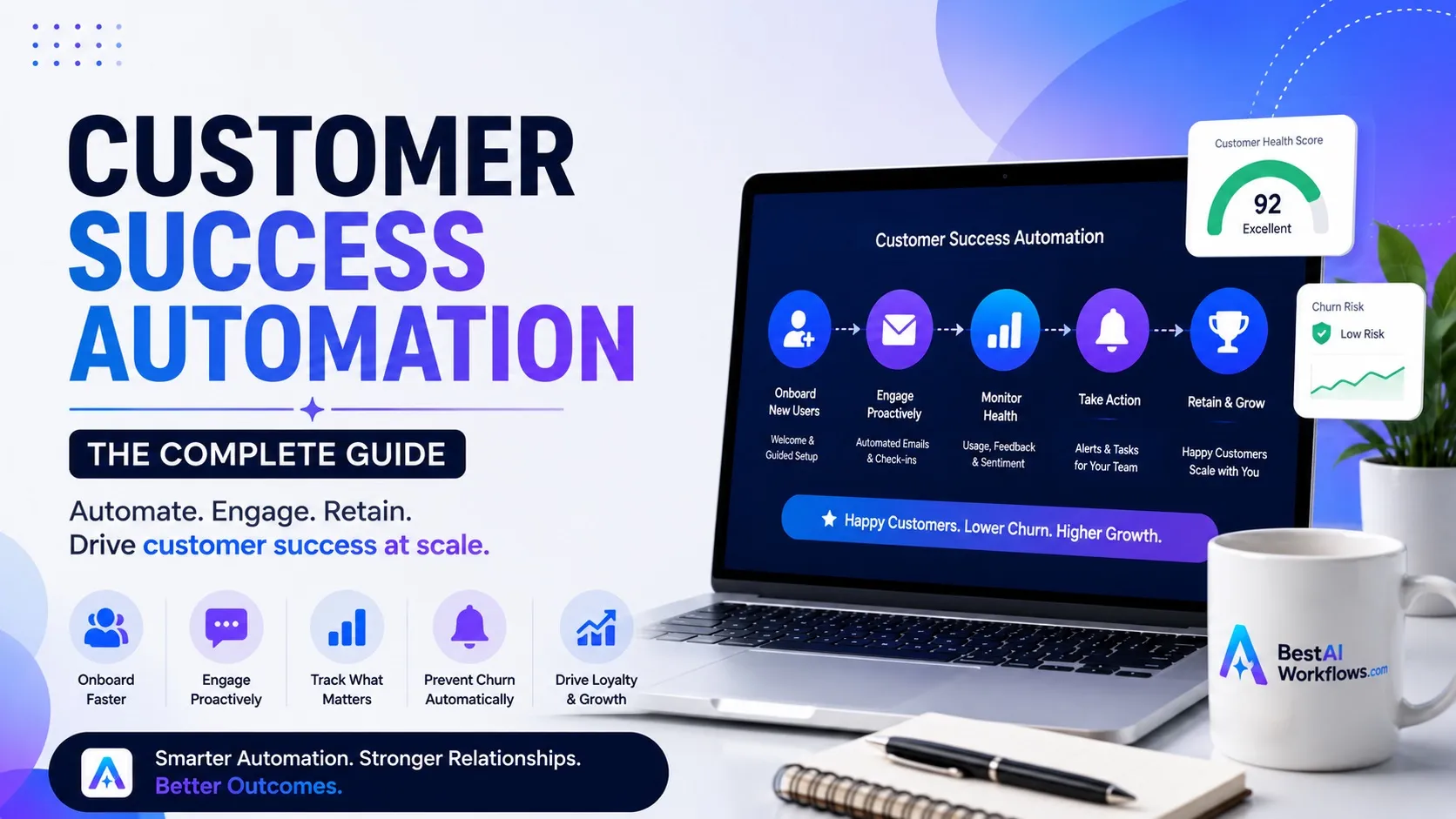
Customer success automation solves these challenges by combining workflow automation, artificial intelligence, and customer data to proactively manage the entire customer lifecycle.
If you’re building a modern customer operations strategy, this guide complements Best AI Tools for Customer Success Teams, AI Customer Success Workflow: Reduce Churn with Automation, AI Workflow for Customer Retention, and Best AI CRM Software for Sales Teams in 2026. Together, these resources help businesses create a connected experience that spans sales, onboarding, support, and long-term customer growth.
What Is Customer Success Automation?
Customer success automation is the process of using software, artificial intelligence, and predefined workflows to automate repetitive customer success tasks while improving customer engagement throughout the customer lifecycle.
Instead of manually monitoring every account, businesses can automatically:
- Track customer health scores
- Identify churn risks
- Trigger onboarding sequences
- Schedule success check-ins
- Send renewal reminders
- Monitor product adoption
- Generate executive reports
- Notify Customer Success Managers when intervention is needed
AI customer success automation enables teams to focus on building relationships rather than performing administrative work.
Why Customer Success Automation Matters
Retaining an existing customer is generally more cost-effective than acquiring a new one. Yet many businesses still invest heavily in acquisition while relying on manual processes to manage retention.
Automating customer success helps businesses scale without sacrificing customer experience.
Key Benefits
Reduce Customer Churn
AI identifies warning signs before customers cancel or downgrade.
Increase Customer Lifetime Value
Automated engagement encourages product adoption, renewals, and upsells.
Improve Team Productivity
Routine follow-ups, reminders, and reporting happen automatically.
Deliver Personalized Experiences
Customers receive relevant communication based on their lifecycle stage and behavior.
Improve Decision-Making
Customer success platforms provide real-time insights into account health and engagement.
Customer Success Automation vs Customer Support Automation
Although the two functions often work together, they serve different purposes.
| Customer Success Automation | Customer Support Automation |
|---|---|
| Focuses on long-term relationships | Focuses on resolving issues |
| Improves product adoption | Solves customer problems |
| Prevents churn | Responds to support requests |
| Drives renewals and expansion | Reduces response times |
| Uses health scores and engagement data | Uses tickets and knowledge bases |
A mature business typically combines both strategies to create an exceptional customer experience.
Key Components of a Customer Success Automation Strategy
1. Automated Customer Onboarding
The customer journey begins immediately after a purchase.
An automated onboarding workflow can:
- Send welcome emails
- Share training resources
- Assign onboarding tasks
- Schedule kickoff meetings
- Track onboarding progress
This ensures every customer receives a consistent experience.
2. Customer Health Scoring
Health scores help identify customers who are thriving and those who may require attention.
AI evaluates signals such as:
- Product usage
- Login frequency
- Feature adoption
- Support tickets
- Survey responses
- Renewal history
Accounts with declining health scores can automatically trigger alerts for Customer Success Managers.
3. Product Adoption Monitoring
Many customers fail to realize the full value of a product because they never discover key features.
Automation platforms can detect underused functionality and send educational content or training recommendations to improve adoption.
4. Renewal Automation
Rather than relying on manual reminders, workflows can automatically:
- Notify customers before renewal dates
- Generate renewal proposals
- Schedule review meetings
- Alert account managers
This reduces the risk of accidental churn.
5. Churn Prevention
AI can detect early warning signs, including:
- Reduced product usage
- Declining engagement
- Increased support requests
- Negative survey responses
- Missed milestones
When these signals appear, automated workflows can assign follow-up tasks or notify the appropriate team member.
Customer Success Automation Workflow
A typical workflow looks like this:
Customer Purchase
↓
Welcome Email
↓
Product Onboarding
↓
Usage Tracking
↓
Customer Health Score
↓
Risk Analysis
↓
Success Manager Alert (if required)
↓
Personalized Engagement
↓
Renewal Reminder
↓
Expansion Opportunity
↓
Customer Advocacy
This workflow connects naturally with AI Customer Success Workflow and AI Workflow for Customer Retention, ensuring customers continue receiving value long after the initial sale.
Best Customer Success Automation Platforms
1. Gainsight
Best For
Enterprise customer success teams.
Key Features
- Customer health scoring
- Journey orchestration
- Success plans
- AI insights
- Renewal forecasting
Pros
- Comprehensive functionality
- Powerful reporting
Cons
Better suited for larger organizations.
Official Website: https://www.gainsight.com/
2. ChurnZero
Best For
Subscription and SaaS businesses.
Key Features
- Customer health monitoring
- Product usage tracking
- Automated playbooks
- Renewal management
Pros
- Excellent churn prevention
- Strong automation
Cons
Primarily designed for subscription businesses.
Official Website: https://churnzero.com/
3. HubSpot Service Hub
Best For
Businesses already using HubSpot CRM.
Key Features
- CRM integration
- Customer communication
- Workflow automation
- Reporting
- Ticket management
Official Website: https://www.hubspot.com/products/service
4. Vitally
Best For
Growing SaaS companies.
Key Features
- Customer health dashboards
- Lifecycle automation
- Success planning
- Product analytics
Official Website: https://www.vitally.io/
5. Totango
Best For
Businesses looking for scalable customer success automation.
Key Features
- Success programs
- Automated campaigns
- Health monitoring
- Customer segmentation
Official Website: https://www.totango.com/
How to Implement Customer Success Automation
Step 1: Map the Customer Journey
Identify every touchpoint from onboarding through renewal.
Step 2: Define Customer Health Metrics
Choose measurable indicators that reflect customer engagement and success.
Step 3: Automate Repetitive Tasks
Start with processes such as onboarding emails, renewal reminders, and health alerts.
Step 4: Integrate Your CRM
Connecting customer success software with your CRM creates a complete view of each customer relationship. Businesses using CRM-driven sales processes should also review Best AI CRM Software for Sales Teams in 2026.
Step 5: Measure Results
Monitor:
- Customer retention
- Churn rate
- Product adoption
- Expansion revenue
- Customer satisfaction
- Time saved
Common Mistakes to Avoid
Automating Without Personalization
Automation should enhance customer relationships, not replace meaningful human interactions.
Ignoring Customer Feedback
Use surveys, support conversations, and product usage data to refine your workflows.
Tracking Too Many Metrics
Focus on the health indicators that have the strongest relationship with customer retention.
Treating Customer Success as Support
Customer success is proactive, while customer support is reactive. Both functions should work together but remain distinct.
Frequently Asked Questions
What is customer success automation?
Customer success automation uses AI and workflow automation to streamline onboarding, customer engagement, health monitoring, renewal management, and churn prevention.
How does AI improve customer success?
AI analyzes customer behavior, predicts churn risks, recommends next actions, and automates repetitive tasks, allowing Customer Success Managers to focus on strategic relationships.
Which businesses benefit most from customer success automation?
SaaS companies, agencies, subscription businesses, and organizations with recurring revenue models benefit the most, although any business focused on long-term customer relationships can gain value.
What is customer lifecycle automation?
Customer lifecycle automation manages every stage of the customer journey—from onboarding and adoption to renewal and advocacy—through automated workflows and AI-driven insights.
Is customer success automation worth the investment?
Yes. Businesses that automate customer success often reduce churn, improve retention, and increase customer lifetime value while allowing their teams to support more accounts efficiently.
Final Verdict
Customer success automation is no longer reserved for enterprise organizations. Modern AI-powered platforms allow businesses of all sizes to proactively engage customers, monitor account health, reduce churn, and increase lifetime value without dramatically expanding their customer success teams.
For most growing businesses, combining customer success software with CRM systems, AI-powered workflows, and lifecycle automation creates a scalable strategy that improves customer satisfaction while reducing manual work.
Start by automating your onboarding process and customer health monitoring, then expand into renewal management, product adoption campaigns, and predictive churn prevention as your customer success program matures.