
Time to Read:
Table of Contents
Introduction
Every business generates knowledge every day. Sales teams record customer insights, HR creates onboarding documentation, support teams solve recurring issues, marketing develops campaign playbooks, and operations document standard operating procedures.
The challenge isn’t creating knowledge—it’s making sure the right people can find and use it when they need it.
This is where AI knowledge management transforms the way organizations work.
Unlike traditional knowledge management, which often relies on static folders and manual searches, AI-powered knowledge management systems help businesses automatically organize information, understand context, retrieve relevant answers, and continuously improve organizational knowledge.
When implemented correctly, AI knowledge management becomes the foundation for workflow automation, AI agents, customer support, employee onboarding, and business decision-making.
This guide explains how to implement AI knowledge management across your organization—from capturing information to keeping it accurate and useful over time.
Looking to purchase software instead?
Read our comparison guide: Best AI Knowledge Management Software in 2026
That article helps you choose the right platform, while this guide focuses on implementation.
What Is AI Knowledge Management?
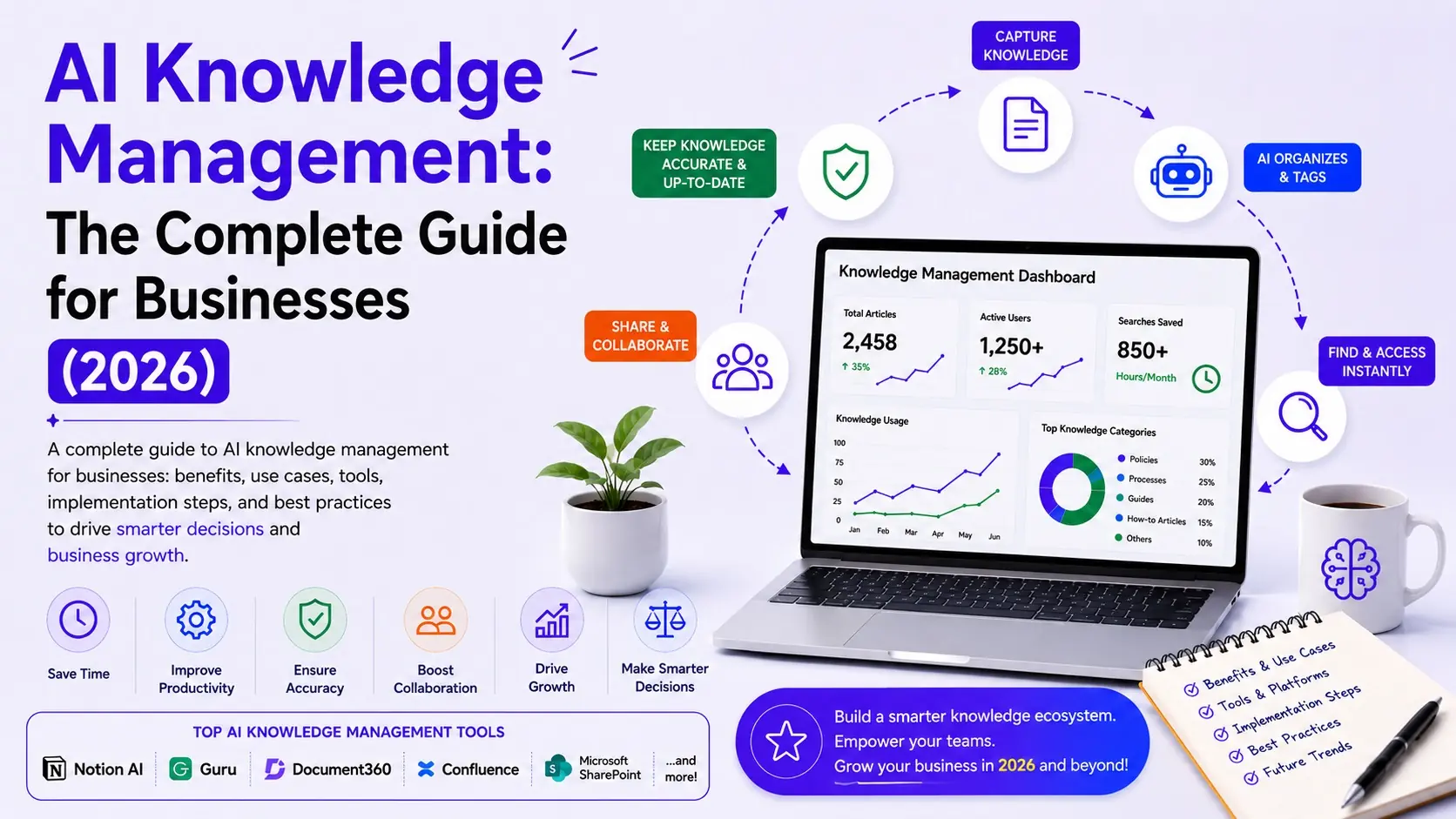
AI knowledge management is the practice of using artificial intelligence to capture, organize, enrich, search, retrieve, share, and continuously improve business knowledge.
Instead of employees spending valuable time searching through documents or asking coworkers repetitive questions, AI helps deliver relevant information instantly.
A complete AI knowledge management system typically combines:
- Knowledge capture
- Documentation
- AI search
- Enterprise search
- Internal knowledge bases
- Workflow automation
- AI assistants
- AI agents
- Knowledge governance
- Continuous improvement
The objective isn’t simply storing information—it’s making organizational knowledge actionable.
Why AI Knowledge Management Matters
Knowledge is one of the most valuable business assets.
Without an organized knowledge strategy, businesses often experience:
- Duplicate work
- Repeated questions
- Inconsistent customer responses
- Slow onboarding
- Lost institutional knowledge
- Poor collaboration
- Inefficient decision-making
AI helps solve these problems by making knowledge easier to create, discover, and maintain.
Benefits
- Faster employee onboarding
- Better customer support
- Improved collaboration
- Reduced operational costs
- Higher employee productivity
- Better business decisions
- Easier workflow automation
- More effective AI agents
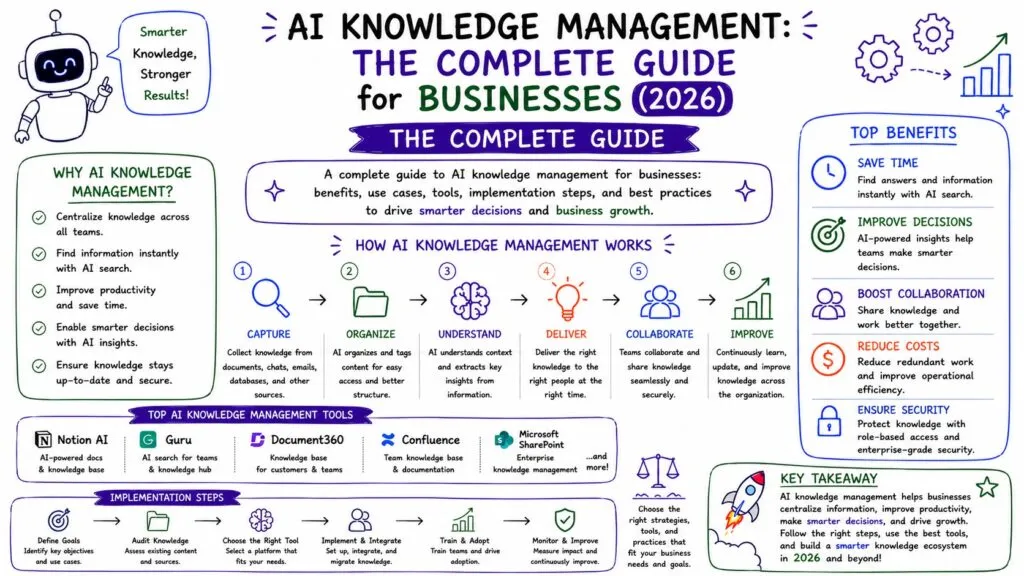
The AI Knowledge Management Lifecycle
A successful implementation follows seven connected stages.
1. Capture
Everything begins with capturing knowledge.
Business knowledge comes from:
- Meetings
- Customer conversations
- SOPs
- Emails
- Training
- Product documentation
- Sales playbooks
- Support tickets
- Project documentation
- Policies
Rather than allowing this information to remain scattered across dozens of applications, organizations should collect it into structured knowledge repositories.
Best Practices
- Standardize documentation formats.
- Capture recurring processes.
- Document decisions.
- Record lessons learned.
- Encourage team contributions.
Related reading:
- AI SOP Generator: Create Standard Operating Procedures Faster
- Best AI Documentation Tools for Businesses
2. Organize
After capturing information, it must be organized into a structure that both people and AI systems can understand.
Examples include:
Departments
↓
Teams
↓
Projects
↓
Processes
↓
Policies
↓
Knowledge Articles
↓
Supporting Documents
Metadata such as ownership, department, review date, document type, and security level make knowledge easier to manage.
3. Enrich
This is where AI begins adding significant value.
Instead of storing documents exactly as written, AI can enrich knowledge by:
- Creating summaries
- Generating tags
- Identifying duplicate content
- Suggesting related articles
- Translating documentation
- Extracting action items
- Identifying missing information
- Recommending updates
The result is a smarter, more connected knowledge base.
4. Search
Employees should never need to remember exactly where information is stored.
Modern AI knowledge management systems provide:
- Natural-language search
- Semantic search
- Enterprise search
- Context-aware search
- Permission-aware search
Example:
Instead of searching:
CRM pricing approval
Employees ask:
“Who approves enterprise CRM discounts?”
AI returns the relevant policy together with supporting documentation.
5. Retrieve
Finding documents isn’t enough.
AI should retrieve:
- The correct answer
- Supporting documents
- Related procedures
- Relevant policies
- Similar cases
- Recent updates
The best systems explain why an answer was returned and cite the source.
6. Share
Knowledge becomes valuable only when it is shared.
AI enables knowledge sharing through:
- Internal chat assistants
- Company wikis
- Employee portals
- AI copilots
- Customer support systems
- Sales enablement tools
- Mobile access
The goal is to provide the right information to the right employee at the right time.
7. Update
Knowledge constantly changes.
Products evolve.
Policies change.
Processes improve.
Software updates.
AI can help identify:
- Outdated articles
- Broken links
- Missing documentation
- Frequently requested topics
- Duplicate content
This creates a continuous improvement cycle rather than a static documentation library.
AI Knowledge Management Workflow
Capture Knowledge
↓
Organize Information
↓
AI Enriches Content
↓
Knowledge Indexed
↓
Employee Asks Question
↓
AI Searches Sources
↓
Relevant Answer Retrieved
↓
Knowledge Shared
↓
Feedback Collected
↓
Documentation Updated
Department Workflows
Sales
Sales teams need instant access to pricing, proposals, playbooks, product documentation, competitor comparisons, and objection handling.
Sales Workflow
Customer Inquiry
↓
AI Searches Knowledge Base
↓
Pricing Retrieved
↓
Proposal Template Found
↓
Case Studies Suggested
↓
Sales Representative Responds
Related Articles
- AI Sales Workflow: The Complete Guide for Modern Businesses
- Best AI Sales Assistants for Small Businesses
- AI Lead Qualification
HR
HR departments maintain:
- Employee handbooks
- Policies
- Onboarding guides
- Benefits
- Training documentation
HR Workflow
New Employee
↓
AI Onboarding Assistant
↓
Policies Retrieved
↓
Training Assigned
↓
Questions Answered
↓
Knowledge Updated
Customer Support
Support teams depend heavily on accurate documentation.
Customer Support Workflow
Customer Question
↓
AI Knowledge Search
↓
Relevant Article Retrieved
↓
Chatbot Answers
↓
Escalation if Needed
↓
Knowledge Updated
Related Reading
- Best AI Customer Service Software
- Best AI Help Desk Software
- Best AI Chatbots for Customer Support
- AI Workflow for Customer Support
Marketing
Marketing teams create:
- Brand guidelines
- SEO documentation
- Campaign playbooks
- Content calendars
- Analytics reports
Marketing Workflow
Campaign Brief
↓
AI Finds Templates
↓
Previous Campaign Data
↓
Brand Guidelines
↓
Content Created
↓
Results Stored
Related Articles
- AI Marketing Workflow
- Best AI Tools for Marketing Teams
- Best AI Content Creation Tools
- Best AI SEO Tools
Operations
Operations teams manage SOPs, procurement procedures, quality standards, compliance documentation, and recurring business processes.
Operations Workflow
Process Updated
↓
AI Detects Change
↓
SOP Updated
↓
Teams Notified
↓
Automation Updated
↓
Documentation Reviewed
Related Reading
- AI Business Process Automation
- AI Workflow Automation for Small Businesses
- Workflow Automation for Small Businesses
- AI Workflow for Invoice Processing
Best Practices
Standardize Documentation
Create templates for SOPs, policies, meeting notes, and project documentation.
Assign Ownership
Every document should have an owner responsible for updates.
Review Regularly
Schedule quarterly or biannual documentation reviews.
Secure Sensitive Information
Use permissions and role-based access controls.
Connect Business Systems
Integrate CRM, HR, project management, customer support, and documentation platforms into one searchable knowledge ecosystem.
Common Mistakes
Treating Knowledge Management as Documentation Only
Knowledge management includes discovery, governance, collaboration, and continuous improvement.
Ignoring Governance
Without review processes, AI may surface outdated or conflicting information.
Building Silos
Connect knowledge across departments instead of creating isolated repositories.
Not Measuring Success
Track:
- Search success rate
- Time to find information
- Employee adoption
- Duplicate content reduction
- Support ticket deflection
- Onboarding completion time
Recommended Software
The following platforms work well for implementing AI knowledge management:
| Platform | Best For |
|---|---|
| Notion AI | All-around knowledge management |
| Guru | Enterprise knowledge |
| Glean | Enterprise search |
| Confluence + Rovo | Technical organizations |
| Document360 | Documentation and knowledge bases |
| Slite | Internal documentation |
| Tettra | Small business knowledge sharing |
| Microsoft SharePoint + Copilot | Microsoft organizations |
For detailed comparisons, read: Best AI Knowledge Management Software in 2026
Frequently Asked Questions
What is AI knowledge management?
AI knowledge management uses artificial intelligence to help businesses capture, organize, search, retrieve, share, and maintain organizational knowledge.
What is an AI knowledge management system?
An AI knowledge management system combines documentation, enterprise search, AI search, knowledge bases, workflow automation, and governance into one platform.
How is AI used in enterprise knowledge management?
Organizations use AI to improve search, summarize documentation, answer employee questions, automate documentation updates, support onboarding, and enable AI assistants.
What’s the difference between documentation and knowledge management?
Documentation focuses on creating information.
Knowledge management focuses on capturing, organizing, maintaining, retrieving, sharing, and improving that information across the organization.
Can AI replace knowledge managers?
No. AI accelerates knowledge management by automating repetitive tasks, but people are still responsible for governance, accuracy, compliance, and strategic knowledge planning.
Final Verdict
Successful AI knowledge management isn’t about buying software—it’s about creating a sustainable system that keeps organizational knowledge accurate, accessible, and actionable.
Businesses should first establish a structured lifecycle: Capture → Organize → Enrich → Search → Retrieve → Share → Update. Once this foundation is in place, AI can enhance every stage by improving search, generating documentation, identifying outdated content, and supporting employees with context-aware answers.
Whether you’re implementing AI across sales, HR, customer support, marketing, or operations, a well-designed knowledge management strategy becomes the backbone of workflow automation, AI agents, and data-driven decision-making.
When combined with the right platform, strong governance, and ongoing maintenance, AI knowledge management transforms scattered information into a strategic business asset.