
Time to Read:
Table of Contents
Introduction
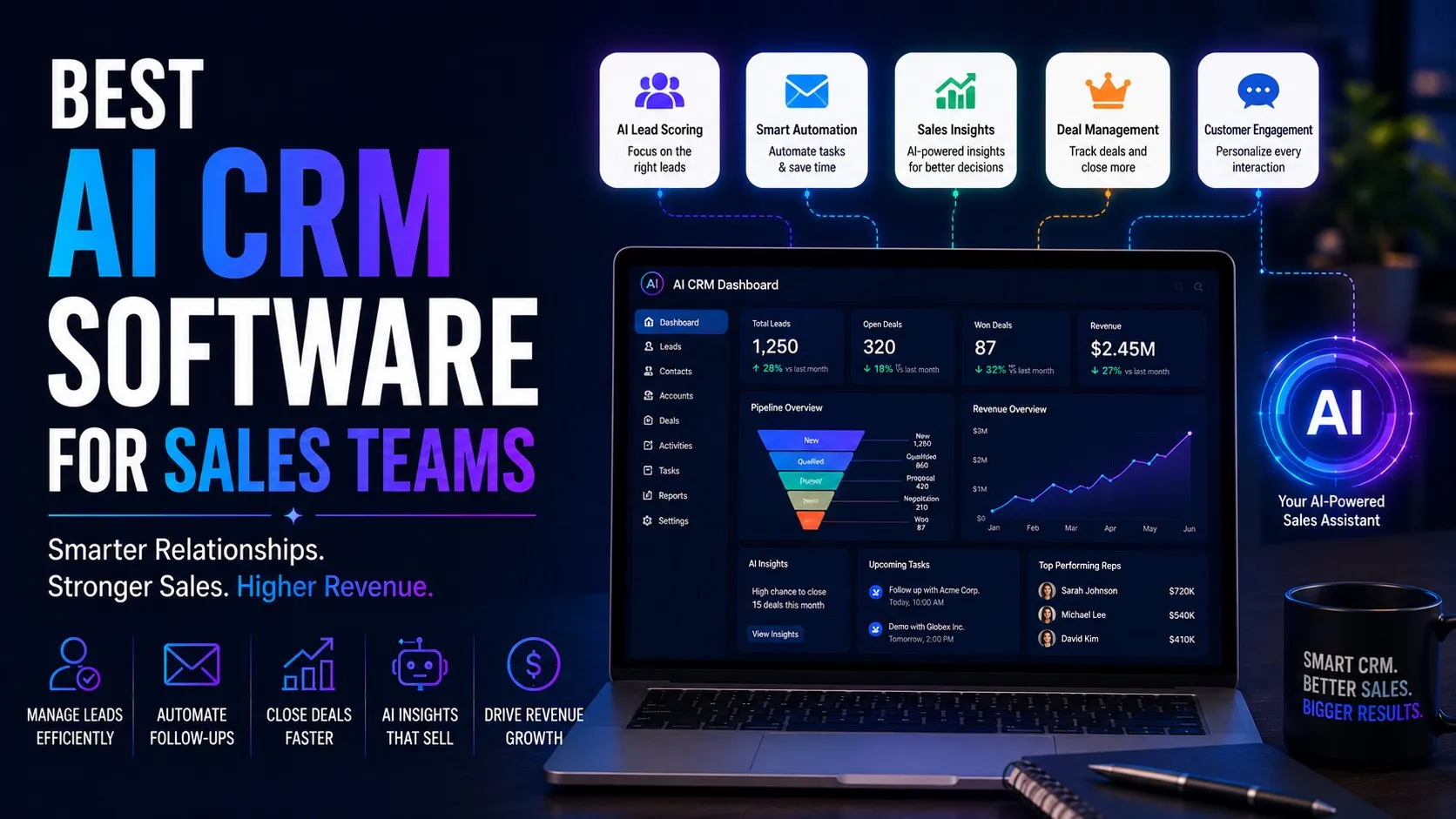
Customer Relationship Management (CRM) software has evolved far beyond storing contact information. Modern AI-powered CRM platforms can score leads, predict deal outcomes, automate follow-ups, summarize meetings, recommend next actions, and generate accurate sales forecasts.
For sales teams, this means less time spent on administrative work and more time focused on building relationships and closing deals.
Whether you’re a startup searching for your first CRM or an enterprise looking to upgrade your sales technology stack, choosing the right AI CRM software can have a significant impact on productivity and revenue.
This guide compares the best AI CRM software for sales teams in 2026, including key features, pricing, advantages, disadvantages, and the ideal use cases for each platform.
Why AI-Powered CRM Software Matters
Traditional CRM systems require manual updates and often become outdated because sales representatives don’t have time to maintain them.
AI changes this by automatically collecting data, updating records, identifying sales opportunities, and providing actionable insights.
Benefits of AI CRM Software
Automates Administrative Work
AI updates contact records, logs activities, and summarizes meetings automatically.
Improves Lead Prioritization
Predictive lead scoring helps sales teams focus on prospects most likely to convert.
Increases Sales Productivity
Representatives spend more time selling instead of entering data.
Improves Forecast Accuracy
AI analyzes pipeline health and predicts future revenue.
Strengthens Customer Relationships
Personalized communication and intelligent reminders improve customer engagement.
Quick Comparison Table
| CRM Platform | Best For | Starting Price* | AI Features |
| HubSpot Sales Hub | Small & growing businesses | Free & paid | AI email, forecasting, CRM |
| Salesforce Sales Cloud | Enterprise | Paid plans | Einstein AI, automation |
| Zoho CRM | SMBs | Paid plans | Zia AI assistant |
| Pipedrive | Sales pipelines | Paid plans | AI sales assistant |
| Freshsales | Growing sales teams | Free & paid | Freddy AI |
| Microsoft Dynamics 365 | Microsoft ecosystem | Paid plans | Copilot AI |
| Monday CRM | Visual workflow management | Paid plans | AI automations |
| Creatio CRM | Enterprise automation | Custom | AI workflow automation |
| Copper CRM | Google Workspace users | Paid plans | Relationship automation |
| Insightly | Project-driven sales | Paid plans | AI productivity features |
*Pricing varies by plan and region. Always verify current pricing before purchasing.
10 Best AI CRM Software Platforms
1. HubSpot Sales Hub
Best For
Small and medium-sized businesses looking for an all-in-one CRM.
Key Features
- AI email generation
- Lead scoring
- Pipeline management
- Meeting scheduling
- Sales forecasting
Pros
- Excellent user experience
- Free CRM available
- Large integration ecosystem
Cons
- Premium AI capabilities require higher-tier plans.
Pricing
Free CRM available with paid Sales Hub plans.
2. Salesforce Sales Cloud
Best For
Large organizations and enterprise sales teams.
Key Features
- Einstein AI
- Predictive forecasting
- Opportunity scoring
- Workflow automation
- Revenue intelligence
Pros
- Highly customizable
- Enterprise scalability
- Extensive partner ecosystem
Cons
- Higher implementation complexity and cost.
Pricing
Subscription-based with multiple editions.
3. Zoho CRM
Best For
Small businesses looking for affordable AI CRM software.
Key Features
- Zia AI assistant
- Workflow automation
- Sales forecasting
- Email intelligence
Pros
- Competitive pricing
- Comprehensive feature set
Cons
- Interface can feel crowded.
4. Pipedrive
Best For
Sales pipeline management.
Key Features
- AI sales assistant
- Deal probability scoring
- Sales pipeline visualization
- Activity reminders
Pros
- Easy to learn
- Excellent pipeline management
Cons
- Limited marketing functionality.
5. Freshsales
Best For
Growing businesses needing an affordable AI CRM.
Key Features
- Freddy AI
- Lead scoring
- Email tracking
- Built-in calling
Pros
- Good value
- Easy implementation
Cons
- Smaller ecosystem than some competitors.
6. Microsoft Dynamics 365 Sales
Best For
Organizations already using Microsoft 365.
Key Features
- Microsoft Copilot
- AI insights
- Sales forecasting
- Opportunity management
Pros
- Excellent Microsoft integration
Cons
- Steeper learning curve.
7. Monday CRM
Best For
Visual sales workflow management.
Key Features
- AI workflow builder
- Task automation
- Deal tracking
- Team collaboration
Pros
- Flexible interface
Cons
- Advanced customization may require setup time.
8. Creatio CRM
Best For
Enterprise process automation.
Key Features
- No-code workflows
- AI automation
- Sales process management
Pros
- Powerful automation
Cons
- Better suited to larger businesses.
9. Copper CRM
Best For
Google Workspace users.
Key Features
- Gmail integration
- Contact automation
- Pipeline tracking
Pros
- Seamless Google experience
Cons
- Limited advanced AI compared with enterprise CRMs.
10. Insightly
Best For
Businesses combining sales and project delivery.
Key Features
- Relationship management
- Workflow automation
- Project management
- Reporting
Pros
- Good all-in-one solution
Cons
- Fewer AI features than some competitors.
Best AI CRM by Business Type
Startups
Recommended:
- HubSpot Sales Hub
- Zoho CRM
- Freshsales
Small Businesses
Recommended:
- HubSpot
- Pipedrive
- Zoho CRM
Agencies
Recommended:
- HubSpot
- Monday CRM
- Copper CRM
Enterprise
Recommended:
- Salesforce Sales Cloud
- Microsoft Dynamics 365
- Creatio CRM
How to Choose the Right AI CRM
When comparing CRM software, consider:
Ease of Use
Sales teams adopt simple platforms faster.
AI Capabilities
Look for:
- Lead scoring
- Forecasting
- Email generation
- Meeting summaries
- Predictive insights
Integrations
Your CRM should integrate with:
- Email platforms
- Marketing automation
- Proposal software
- Calendar applications
- Workflow automation tools
Pricing
Consider both current requirements and future growth.
Common Mistakes to Avoid
Buying More CRM Than You Need
Small teams rarely require enterprise-level functionality.
Ignoring User Adoption
A CRM is only valuable if sales representatives actually use it.
Poor Data Quality
AI performs best with accurate CRM data.
Not Automating Workflows
Automation is one of the biggest advantages of modern AI CRM platforms.
Frequently Asked Questions
What is the best AI CRM for sales teams?
HubSpot Sales Hub is one of the best all-around options for growing businesses, while Salesforce Sales Cloud is ideal for enterprise organizations.
What is an AI CRM?
An AI CRM combines traditional customer relationship management with artificial intelligence to automate tasks, generate insights, and improve sales performance.
Can AI update CRM records automatically?
Yes. Many modern CRM platforms automatically log activities, summarize meetings, and update contact records.
Which AI CRM is best for small businesses?
HubSpot, Zoho CRM, Freshsales, and Pipedrive are excellent choices for smaller sales teams.
Is AI CRM software worth the investment?
For most businesses, AI CRM software improves productivity, data quality, and sales efficiency, making it a worthwhile investment.
Final Verdict
The best AI CRM software for sales teams depends on your business size, budget, and existing technology stack.
HubSpot Sales Hub remains one of the strongest choices for growing businesses because it combines ease of use, AI-powered features, and an extensive integration ecosystem. Salesforce Sales Cloud continues to lead the enterprise market with powerful AI capabilities through Einstein.
Businesses looking for affordability should consider Zoho CRM or Freshsales, while Pipedrive excels at pipeline management and Microsoft Dynamics 365 is an excellent choice for organizations already invested in Microsoft’s ecosystem.
The most successful sales teams choose a CRM that fits their current needs while providing room to grow as their business scales.