
Introduction
Recruitment agencies are expected to deliver qualified candidates faster than ever. Clients want shorter hiring cycles, better candidate quality, and more transparency throughout the recruitment process. At the same time, recruiters face growing application volumes and increasing administrative workloads.
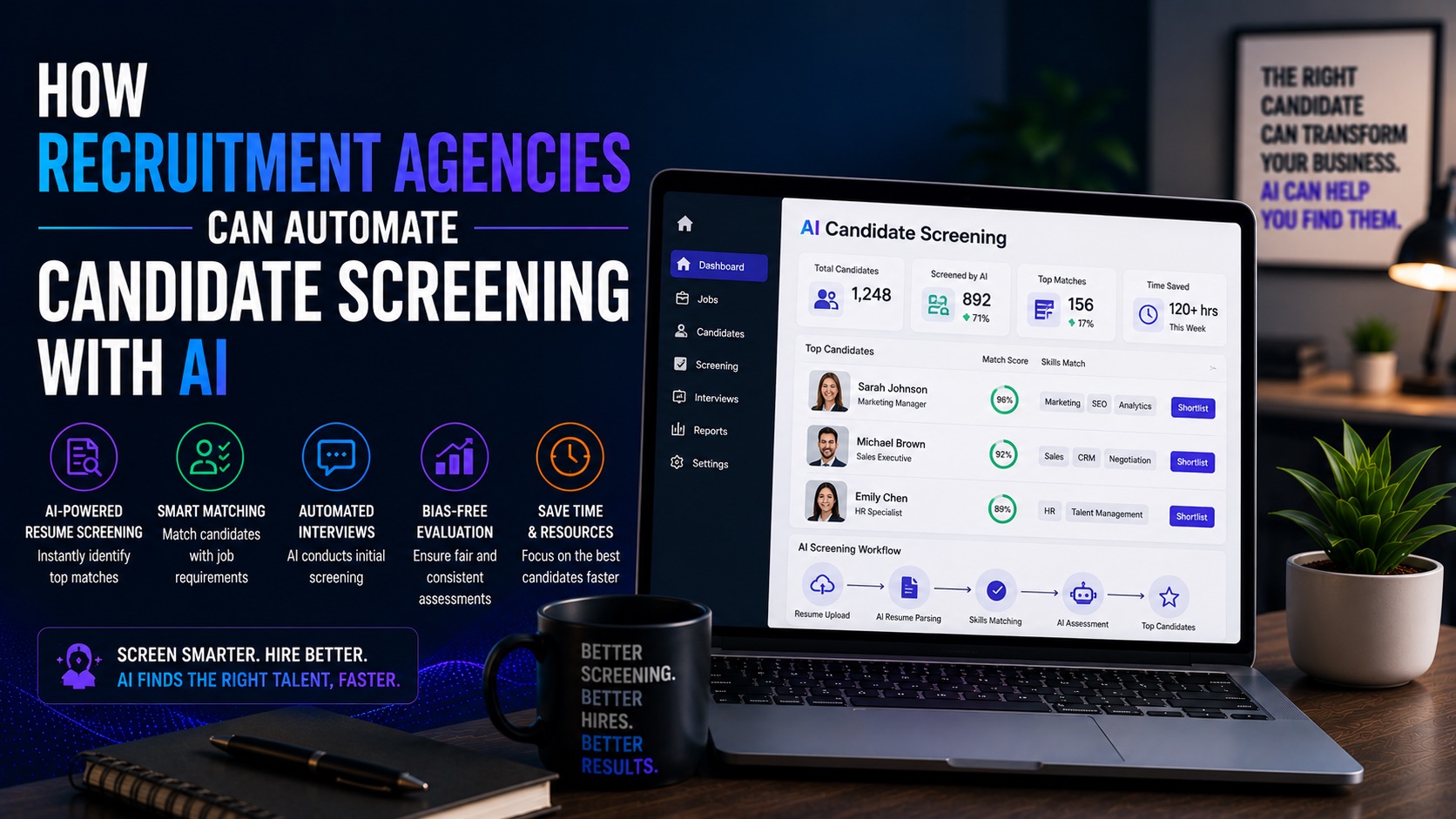
Artificial intelligence is helping agencies solve these challenges. Modern AI candidate screening systems can review resumes, rank applicants, identify skills, analyze experience, and prioritize the most promising candidates before a recruiter even opens a profile.
Instead of spending hours manually reviewing applications, recruiters can focus on interviewing, relationship building, and placements. This article explains how recruitment agencies can automate candidate screening with AI, the tools involved, the workflow design process, common mistakes to avoid, and the business impact agencies can expect.
What Is AI Candidate Screening?
AI candidate screening refers to the use of artificial intelligence to evaluate job applicants automatically. AI systems analyze resumes, application forms, skills, experience, certifications, education, and other data points to determine candidate suitability.
Unlike traditional keyword matching systems, modern AI tools can identify relationships between skills, job titles, experience levels, and role requirements. This helps agencies reduce screening time while improving candidate quality.
AI screening does not replace recruiters. Instead, it acts as an intelligent assistant that handles repetitive evaluation tasks and allows recruiters to focus on higher-value activities.
Why Recruitment Agencies Are Adopting AI
Recruitment agencies process hundreds or even thousands of applications every month. Manual screening slows hiring, increases costs, and introduces inconsistency.
AI offers several advantages:
• Faster candidate evaluation
• Reduced administrative work
• Improved recruiter productivity
• Better candidate matching
• Consistent screening criteria
• Shorter time-to-fill
• Improved client satisfaction
• Enhanced reporting and analytics
Agencies that implement AI successfully often gain a competitive advantage by delivering candidates faster than competitors.
The Traditional Candidate Screening Process
Traditionally, recruiters manually review resumes, compare qualifications against job requirements, shortlist candidates, conduct phone screens, schedule interviews, and update recruitment systems.
While effective, this process is time-consuming. Reviewing 200 applications for a single role can consume many hours. Across multiple open positions, the workload becomes difficult to scale.
AI dramatically reduces this burden by automatically analyzing applications and presenting recruiters with ranked candidate lists.
How an AI Recruiting Workflow Works
Step 1: Candidate Application Collection
Applications are collected from job boards, career pages, LinkedIn, referrals, and recruitment campaigns.
Step 2: Resume Parsing
AI extracts candidate information including skills, education, certifications, experience, and employment history.
Step 3: Candidate Scoring
Applicants are evaluated against job requirements and assigned relevance scores.
Step 4: Candidate Ranking
Qualified candidates are prioritized based on experience, skills, and hiring criteria.
Step 5: Automated Communication
AI sends confirmation emails, status updates, and interview invitations.
Step 6: Recruiter Review
Recruiters focus only on highly qualified candidates identified by the system.
Step 7: Interview Scheduling
Automation tools coordinate calendars and schedule interviews.
Step 8: Reporting and Optimization
Performance metrics are tracked to continuously improve hiring outcomes.
Best Tools for AI Candidate Screening
LinkedIn Recruiter AI
Provides AI-powered candidate recommendations and sourcing capabilities. Recruitment agencies often use this platform to reduce manual effort and improve candidate quality.
Bullhorn
Combines recruitment CRM functionality with automation and workflow management. Recruitment agencies often use this platform to reduce manual effort and improve candidate quality.
hireEZ
Helps recruiters discover and engage qualified candidates faster. Recruitment agencies often use this platform to reduce manual effort and improve candidate quality.
SeekOut
Uses AI to improve candidate discovery and talent intelligence. Recruitment agencies often use this platform to reduce manual effort and improve candidate quality.
Manatal
Affordable recruitment software with AI recommendations and applicant ranking. Recruitment agencies often use this platform to reduce manual effort and improve candidate quality.
Zoho Recruit
Popular ATS platform with automation and screening features. Recruitment agencies often use this platform to reduce manual effort and improve candidate quality.
Paradox
Conversational AI platform that automates candidate engagement. Recruitment agencies often use this platform to reduce manual effort and improve candidate quality.
Workable
Hiring platform with AI-assisted screening and job description creation. Recruitment agencies often use this platform to reduce manual effort and improve candidate quality.
Benefits of Recruitment Workflow Automation
Recruitment workflow automation provides measurable benefits throughout the hiring process.
First, it reduces screening time. Recruiters no longer need to manually review every application.
Second, it improves consistency. Every candidate is evaluated using the same criteria.
Third, it improves scalability. Agencies can manage larger candidate volumes without increasing headcount.
Fourth, it enhances candidate experience by providing faster communication and updates.
Finally, it improves reporting and visibility into recruitment performance.
Real-World Example: Automating Candidate Screening
Imagine a recruitment agency receives 500 applications for a customer service role.
Without AI:
• Recruiters manually review every application.
• Screening takes several days.
• Candidate response times are slow.
With AI:
• Applications are automatically analyzed.
• Candidates are scored and ranked.
• Top candidates are shortlisted immediately.
• Automated emails keep applicants informed.
• Recruiters focus on interviews and placements.
The result is faster hiring and improved efficiency.
Common Mistakes to Avoid
Many agencies make implementation mistakes that limit AI effectiveness.
Avoid relying entirely on automation. Recruiters should always review final decisions.
Avoid poor-quality job descriptions because AI relies on accurate input data.
Avoid ignoring candidate experience. Communication should remain personal and professional.
Avoid implementing too many tools at once. Start with a focused workflow and expand gradually.
Avoid failing to measure performance. Track time-to-fill, screening accuracy, and recruiter productivity.
KPIs to Measure
Important recruitment metrics include:
• Time-to-fill
• Time-to-screen
• Cost-per-hire
• Recruiter productivity
• Candidate satisfaction
• Interview-to-offer ratio
• Offer acceptance rate
• Placement success rate
Monitoring these metrics helps agencies quantify the value of AI investments.
Future of AI Recruiting Workflows
AI recruiting technology continues to evolve rapidly. Future systems will provide deeper candidate insights, better predictive analytics, stronger conversational capabilities, and more sophisticated matching algorithms.
Recruitment agencies that invest in AI today will be better positioned to compete in an increasingly technology-driven market.
Frequently Asked Questions
What is AI candidate screening?
AI candidate screening uses artificial intelligence to evaluate applicants automatically.
Can AI replace recruiters?
No. AI improves efficiency but recruiters remain essential for relationship building and decision-making.
How much time can AI save?
Many agencies reduce screening time by more than 50 percent.
What is recruitment workflow automation?
The automation of sourcing, screening, communication, scheduling, and reporting tasks.
Which tool is best for candidate screening?
The best solution depends on agency size, workflow complexity, and budget.
Internal Linking Opportunities
Recommended internal links:
• Best AI Tools for Recruitment Agencies
• AI Workflow for Customer Support Teams
• Best AI CRM Software for Small Businesses
• How Small Businesses Can Save 20 Hours Per Week Using AI
Final Verdict
AI candidate screening is becoming a core capability for modern recruitment agencies. By automating resume analysis, candidate ranking, communication, scheduling, and reporting, agencies can significantly reduce administrative work and improve placement speed.
The most successful agencies use AI to support recruiters rather than replace them. Human expertise remains critical for interviews, relationship management, and hiring decisions. When combined with strong recruitment processes, AI can create a scalable hiring workflow that improves productivity, candidate quality, and client satisfaction.
Agencies looking to modernize operations should start with candidate screening automation and gradually expand into sourcing, communication, and workflow automation. Over time, these improvements can create a substantial competitive advantage.