
Introduction
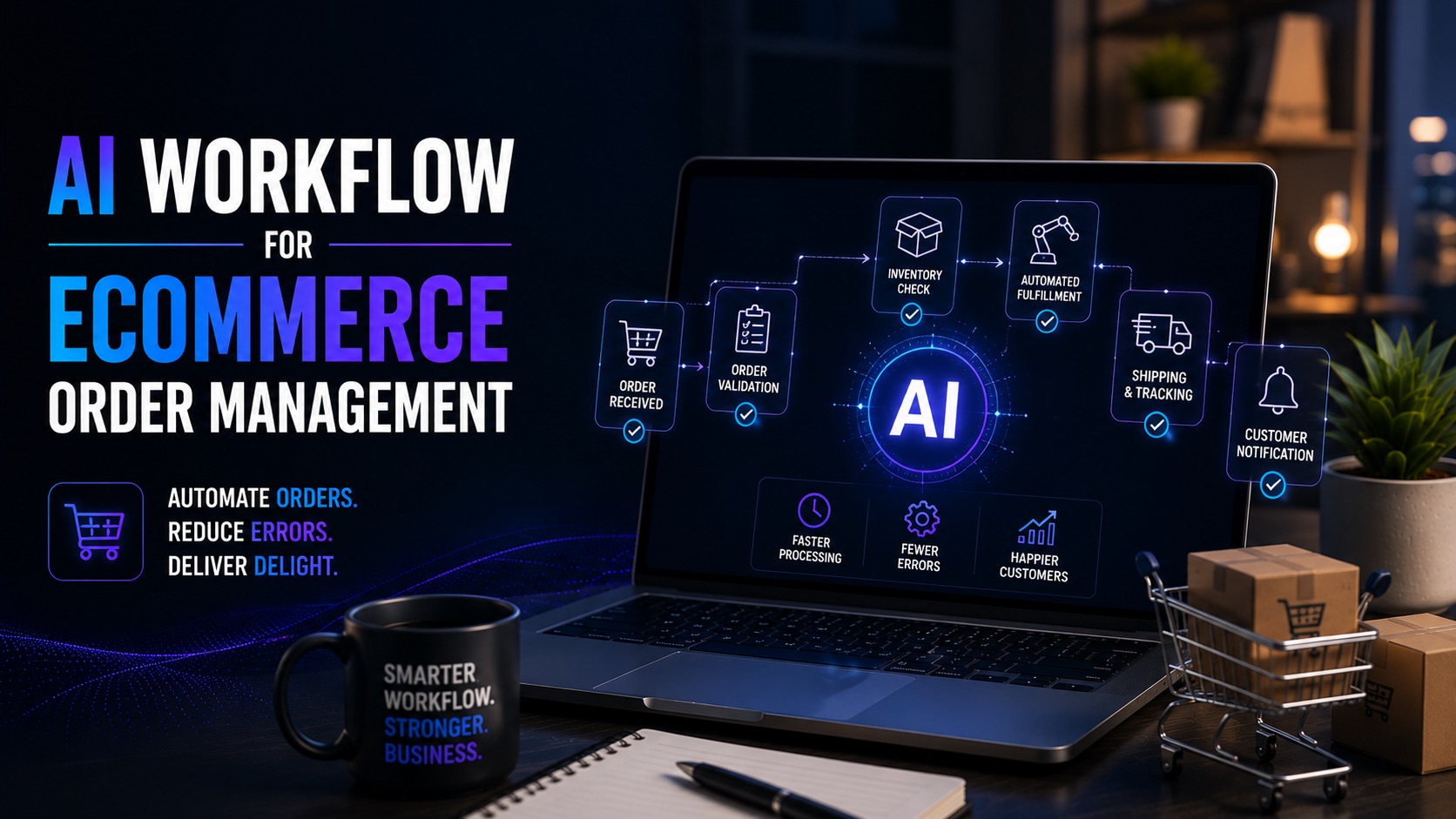
Order management is one of the most important operational functions in ecommerce. Every order must be captured, validated, processed, fulfilled, tracked, delivered, and supported. As online stores grow, manual order management quickly becomes difficult to scale.
Artificial intelligence is helping ecommerce businesses automate large portions of the order lifecycle. AI can classify orders, detect fraud, predict inventory requirements, automate fulfillment decisions, update customers, process returns, and generate operational reports. These capabilities reduce human workload while improving accuracy and customer satisfaction.
This guide explains how to build a complete AI ecommerce workflow for order management, the tools required, implementation best practices, key performance indicators, and common mistakes to avoid.
Why Ecommerce Businesses Need AI Order Management
Modern ecommerce businesses often process hundreds or thousands of orders every month. Manual workflows create bottlenecks that slow growth and increase operational costs.
Common challenges include:
- Inventory inaccuracies
- Delayed order processing
- Customer service overload
- Fraud risks
- Manual data entry
- Reporting inefficiencies
- Return management complexity
AI helps solve these problems through automation, predictive analytics, and workflow orchestration.
Benefits of Ecommerce Process Automation
Businesses that implement ecommerce automation workflows often experience measurable improvements in operational performance.
Major benefits include:
- Faster order processing
- Reduced human error
- Improved inventory visibility
- Better customer communication
- Lower operating costs
- Faster fulfillment
- Improved customer satisfaction
- Better scalability
Understanding the Ecommerce Order Lifecycle
Before building an AI workflow, it is important to understand the complete ecommerce order lifecycle.
- Order Placement
- Payment Verification
- Fraud Screening
- Inventory Allocation
- Warehouse Fulfillment
- Shipping Coordination
- Customer Notifications
- Delivery Tracking
- Returns Management
- Reporting and Optimization
Each stage can benefit from automation.
Step-by-Step AI Ecommerce Workflow
Step 1: Capture Orders Automatically
Orders are collected from ecommerce platforms such as Shopify, WooCommerce, BigCommerce, Amazon, Etsy, and other sales channels.
Automation tools synchronize all orders into a centralized system. AI validates incoming information and identifies potential issues immediately.
Step 2: Verify Payments
AI systems evaluate payment information and identify anomalies. Suspicious transactions can be flagged for manual review while legitimate orders continue through the workflow automatically.
This reduces fraud while minimizing delays.
Step 3: Fraud Detection
Fraud prevention is one of the highest-value AI applications in ecommerce.
AI evaluates:
- Customer behavior
- Geographic location
- Device fingerprints
- Historical purchase patterns
- Risk indicators
High-risk orders can be isolated automatically.
Step 4: Inventory Validation
AI verifies inventory availability before fulfillment begins.
The system checks:
- Current stock levels
- Reserved inventory
- Warehouse locations
- Supplier availability
When inventory is unavailable, customers can be notified automatically.
Step 5: Intelligent Fulfillment Routing
Businesses operating multiple warehouses benefit significantly from AI.
The system determines:
- Optimal fulfillment location
- Shipping cost
- Delivery speed
- Warehouse workload
Orders are routed to the most efficient fulfillment center.
Step 6: Warehouse Automation
AI can generate picking instructions, optimize packing processes, and prioritize urgent orders.
Benefits include:
- Faster picking
- Reduced errors
- Better labor utilization
- Improved throughput
Step 7: Shipping Automation
Shipping software integrates with carriers and automatically generates labels, tracking numbers, and shipping documentation.
AI can recommend:
- Lowest-cost carrier
- Fastest delivery option
- Best customer experience option
Step 8: Customer Communication
Customers expect transparency throughout the order journey.
AI automates:
- Order confirmations
- Shipping notifications
- Delivery updates
- Delay notifications
- Customer service responses
This significantly reduces support workload.
Step 9: Delivery Monitoring
AI monitors shipments and identifies potential delivery issues.
Examples include:
- Carrier delays
- Lost packages
- Address problems
- Failed delivery attempts
Proactive communication improves customer satisfaction.
Step 10: Returns Management
Returns are a major operational challenge for ecommerce businesses.
AI can automate:
- Return approvals
- Return label generation
- Refund processing
- Inventory restocking decisions
This creates a smoother customer experience.
Step 11: Financial Reconciliation
Orders, payments, refunds, taxes, and shipping costs must be reconciled accurately.
AI helps automate accounting workflows and reduces manual bookkeeping effort.
Step 12: Reporting and Optimization
Operational dashboards provide insights into:
- Order volume
- Fulfillment speed
- Shipping performance
- Customer satisfaction
- Inventory turnover
- Return rates
These insights support continuous improvement.
Best Tools for AI Order Management
Shopify Flow
Shopify Flow enables ecommerce automation across order management, inventory, customer communication, and operational workflows.
Best For:
Shopify-based stores seeking built-in automation.
Zapier
Zapier connects ecommerce platforms with CRM systems, email platforms, accounting software, and customer support tools.
Best For:
Businesses seeking simple no-code automation.
Make
Make provides advanced visual workflow automation.
Best For:
Complex ecommerce workflows requiring sophisticated logic.
Klaviyo
Klaviyo uses customer data to automate email marketing and communication throughout the order lifecycle.
Best For:
Customer retention and post-purchase communication.
Gorgias
Gorgias centralizes ecommerce customer support and automates repetitive support requests.
Best For:
Customer service automation.
ShipStation
ShipStation streamlines shipping operations and integrates with multiple carriers.
Best For:
Shipping automation.
Cin7
Cin7 provides inventory management and order orchestration capabilities.
Best For:
Inventory-intensive businesses.
Brightpearl
Brightpearl offers retail operations automation including inventory, fulfillment, and reporting.
Best For:
Growing ecommerce brands.
AI Workflow Example: Small Ecommerce Store
A small Shopify business can implement:
Shopify Flow
- Klaviyo
- ChatGPT
- ShipStation
Workflow:
Order Received → Payment Verified → Shipping Label Created → Customer Updated → Delivery Tracked → Review Request Sent
This workflow can eliminate hours of manual work every week.
AI Workflow Example: Mid-Sized Ecommerce Brand
A growing brand might implement:
Shopify
- Make
- Klaviyo
- Gorgias
- Inventory Management Platform
Benefits:
- Multi-channel order synchronization
- Automated support
- Advanced reporting
- Inventory forecasting
AI Workflow Example: Enterprise Ecommerce Operation
Enterprise organizations often combine:
ERP
- WMS
- CRM
- AI Analytics
- Automation Platforms
The result is a fully integrated operational ecosystem capable of handling large order volumes efficiently.
KPIs to Measure
Successful ecommerce automation initiatives should track:
- Order Processing Time
- Fulfillment Accuracy
- Average Shipping Time
- Customer Satisfaction Score
- Return Rate
- Cost Per Order
- Inventory Turnover
- Revenue Per Customer
- Support Ticket Volume
These metrics help quantify ROI.
Common Mistakes to Avoid
Mistake 1: Automating Broken Processes
Automation amplifies existing workflows. Poor processes should be fixed before automation begins.
Mistake 2: Using Too Many Tools
Complexity increases when businesses implement too many disconnected systems.
Mistake 3: Ignoring Customer Experience
Automation should improve customer experience rather than create frustration.
Mistake 4: Failing to Monitor Performance
Workflows should be reviewed regularly to ensure continued effectiveness.
Mistake 5: Neglecting Data Quality
AI systems depend on accurate data.
Future of AI Ecommerce Workflows
AI capabilities continue to evolve rapidly.
Future innovations may include:
- Predictive fulfillment
- Autonomous inventory purchasing
- Hyper-personalized customer journeys
- Advanced fraud prevention
- Real-time supply chain optimization
Businesses that adopt automation today will be better positioned to compete tomorrow.
Frequently Asked Questions
What is an AI ecommerce workflow?
An AI ecommerce workflow uses artificial intelligence to automate ecommerce operations such as order processing, inventory management, fulfillment, and customer communication.
Can AI automate order management?
Yes. AI can automate large portions of the order lifecycle including validation, routing, fulfillment, tracking, and reporting.
What is ecommerce process automation?
Ecommerce process automation refers to using software and AI to reduce manual work across ecommerce operations.
Which platform is best for ecommerce automation?
The best solution depends on business requirements, but Shopify Flow, Zapier, Make, Klaviyo, and Gorgias are popular choices.
Can small businesses use AI order management?
Absolutely. Many affordable tools are available for small ecommerce businesses.
Final Verdict
AI ecommerce workflows are transforming how online stores manage orders. By automating validation, fulfillment, communication, shipping, returns, and reporting, businesses can improve efficiency while reducing operational costs.
The most successful approach is to begin with one workflow, measure results, and expand gradually. Over time, ecommerce process automation becomes a significant competitive advantage that supports sustainable growth.