
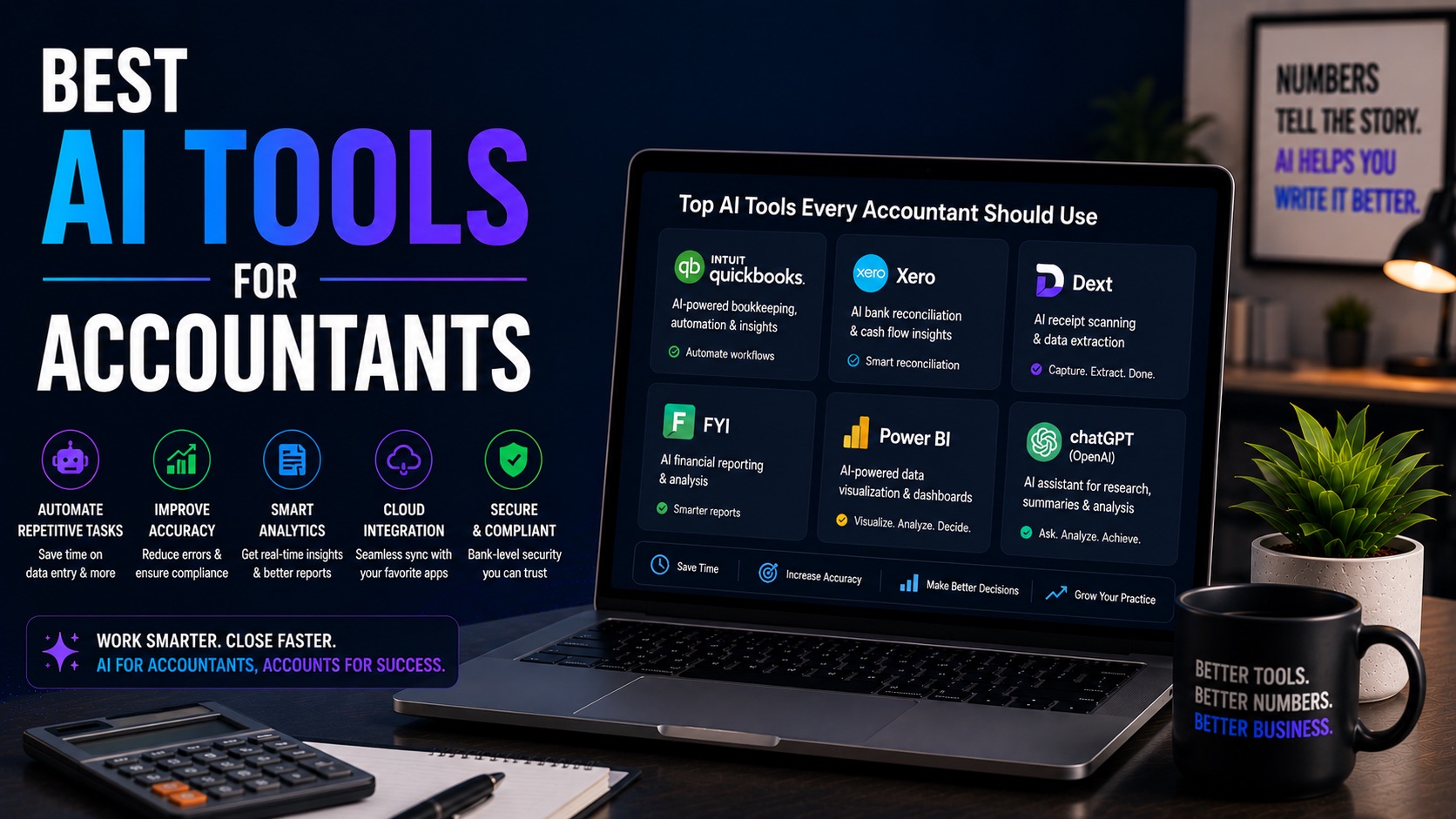
Introduction
Artificial intelligence is rapidly transforming the accounting profession. Tasks that once required hours of manual work—data entry, reconciliation, bookkeeping, reporting, forecasting, and document processing—can now be completed significantly faster with AI-powered software.
For accounting firms and independent accountants, AI offers an opportunity to increase productivity, improve accuracy, reduce costs, and deliver greater value to clients. Instead of spending time on repetitive administrative work, accountants can focus on advisory services, financial strategy, compliance, and business growth.
This guide explores the best AI tools for accountants, how they work, and which platforms provide the greatest return on investment.
Why Accountants Are Adopting AI
Accounting professionals face increasing pressure to process more transactions, provide real-time insights, and maintain compliance. AI helps by automating repetitive processes while improving accuracy and efficiency.
Key benefits include:
• Automated bookkeeping
• Faster reconciliations
• Expense categorization
• Financial forecasting
• Invoice processing
• Tax preparation support
• Audit assistance
• Enhanced reporting
How We Evaluated These Tools
We evaluated each platform based on automation capabilities, ease of use, accounting-specific functionality, integrations, reporting features, scalability, pricing, and suitability for accountants and accounting firms.
Quick Comparison of the Best AI Accounting Tools
QuickBooks Online – Best Overall
Xero – Best for Small Businesses
Vic.ai – Best Accounts Payable Automation
Botkeeper – Best AI Bookkeeping Service
Dext – Best Receipt Processing
Docyt – Best Financial Automation
FreshBooks – Best for Freelancers
Sage Intacct – Best Mid-Market Accounting
FloQast – Best Accounting Operations
Zoho Books – Best Value Option
10 Best AI Tools for Accountants
QuickBooks Online
Industry-leading accounting software with AI-driven categorization, cash flow forecasting, and automated bookkeeping features.
Best For: Accountants seeking efficiency improvements and reduced manual workload.
Pros: Automation, reporting, productivity gains. Cons: Advanced features may require premium plans or onboarding.
Xero
Cloud accounting platform that helps accountants automate bank reconciliation, reporting, and transaction management.
Best For: Accountants seeking efficiency improvements and reduced manual workload.
Pros: Automation, reporting, productivity gains. Cons: Advanced features may require premium plans or onboarding.
Vic.ai
Uses AI to automate accounts payable workflows and invoice processing.
Best For: Accountants seeking efficiency improvements and reduced manual workload.
Pros: Automation, reporting, productivity gains. Cons: Advanced features may require premium plans or onboarding.
Botkeeper
Combines AI and human expertise to deliver bookkeeping automation services.
Best For: Accountants seeking efficiency improvements and reduced manual workload.
Pros: Automation, reporting, productivity gains. Cons: Advanced features may require premium plans or onboarding.
Dext
Automates receipt collection, expense management, and document processing.
Best For: Accountants seeking efficiency improvements and reduced manual workload.
Pros: Automation, reporting, productivity gains. Cons: Advanced features may require premium plans or onboarding.
Docyt
Provides end-to-end financial automation and real-time reporting.
Best For: Accountants seeking efficiency improvements and reduced manual workload.
Pros: Automation, reporting, productivity gains. Cons: Advanced features may require premium plans or onboarding.
FreshBooks
Popular among freelancers and small businesses for invoicing and accounting automation.
Best For: Accountants seeking efficiency improvements and reduced manual workload.
Pros: Automation, reporting, productivity gains. Cons: Advanced features may require premium plans or onboarding.
Sage Intacct
Advanced accounting software with automation and reporting capabilities.
Best For: Accountants seeking efficiency improvements and reduced manual workload.
Pros: Automation, reporting, productivity gains. Cons: Advanced features may require premium plans or onboarding.
FloQast
Helps accounting teams automate close management and compliance workflows.
Best For: Accountants seeking efficiency improvements and reduced manual workload.
Pros: Automation, reporting, productivity gains. Cons: Advanced features may require premium plans or onboarding.
Zoho Books
Affordable accounting solution with automation features for growing businesses.
Best For: Accountants seeking efficiency improvements and reduced manual workload.
Pros: Automation, reporting, productivity gains. Cons: Advanced features may require premium plans or onboarding.
Key Features to Look for in AI Bookkeeping Software
Automated Transaction Categorization
AI-powered automated transaction categorization helps reduce manual accounting work and improve operational efficiency.
Bank Reconciliation
AI-powered bank reconciliation helps reduce manual accounting work and improve operational efficiency.
Invoice Processing
AI-powered invoice processing helps reduce manual accounting work and improve operational efficiency.
Expense Management
AI-powered expense management helps reduce manual accounting work and improve operational efficiency.
Cash Flow Forecasting
AI-powered cash flow forecasting helps reduce manual accounting work and improve operational efficiency.
Tax Preparation Support
AI-powered tax preparation support helps reduce manual accounting work and improve operational efficiency.
Financial Reporting
AI-powered financial reporting helps reduce manual accounting work and improve operational efficiency.
Audit Trail Management
AI-powered audit trail management helps reduce manual accounting work and improve operational efficiency.
How AI Is Transforming Accounting Workflows
Modern accounting firms use AI throughout the client lifecycle. Documents are automatically captured, transactions categorized, invoices processed, and reports generated. This allows accountants to spend more time delivering strategic advice rather than performing repetitive administrative tasks.
Best AI Stack for Accountants
Solo Accountant:
QuickBooks + Dext + ChatGPT
Small Accounting Firm:
Xero + Botkeeper + Dext + Zapier
Growing Practice:
QuickBooks + Vic.ai + FloQast + Power BI
Enterprise Accounting Team:
Sage Intacct + Vic.ai + FloQast + Advanced Analytics
Common Mistakes When Choosing AI Accounting Software
• Choosing software based only on price
• Ignoring integrations
• Failing to train staff
• Overlooking compliance requirements
• Not measuring ROI
• Implementing too many tools at once
Frequently Asked Questions
What is the best AI tool for accountants?
QuickBooks Online remains one of the strongest overall choices.
Can AI replace accountants?
No. AI automates repetitive work but professional judgment remains essential.
What is AI bookkeeping software?
Software that uses AI to automate bookkeeping and accounting processes.
Is AI accounting software worth it?
Most firms see substantial productivity improvements and cost savings.
Which tool is best for invoice automation?
Vic.ai is widely recognized for accounts payable automation.
Final Verdict
The best AI tools for accountants help automate bookkeeping, improve reporting, reduce administrative work, and increase profitability. Whether you are an independent accountant or a growing accounting firm, adopting AI can significantly improve productivity and client service.
The most effective approach is to start with one high-impact automation area, measure results, and gradually expand your AI toolkit.